


Recherche dans le blog
REVERSE OSMOSIS
What Is a Reverse Osmosis System?
Vincent's Bioelectronics and Reverse Osmosis
Why Install a Reverse Osmosis System?
The Health Benefits of a Reverse Osmosis System
- A high-quality drink
- Water that is easy to drink
- More reasons
- Your kidneys will thank you
- More advantages of RO systems
Reverse Osmosis System: Pros and Cons
How to Choose a Home Reverse Osmosis System
- RO water definition
- RO water and health
- RO water and aquariums
- RO water and pH
- RO water and demineralized water
- RO water or spring water?
- How to make RO water
- "A RO system is expensive" - Not anymore!
- How much does RO water cost?
Frequently Asked Questions About RO Systems
- Why are prices so low?
- RO system installation
- Where?
- How much space?
- How long does it take?
- What tools?
- How do you drill a sink?
- How do you connect the water?
- How much does the whole system weigh?
- Home uses
- Baby bottles?
- Ice cubes?
- American-style fridge?
- Face and hair?
- Plants?
- Windshield washers?
- Heating appliances?
- Dishes?
- Windows?
- Maintenance
- Technology
- Advantage of the booster pump?
- Disadvantage of the booster pump?
- Benefit of quick connectors?
- Benefit of a UV sterilizer?
- Benefit of a TDS tester?
- What TDS level can you expect?
- Performance
How to Install a Reverse Osmosis System
Technical Explanations on Using RO Systems
- Why Does TDS Rise in the First Centiliters of Water Produced?
- Why Does TDS Rise When the RO System Is Idle?
- Why Does My Tank-Based RO System Sometimes Start and Sometimes Not?
- My RO System Produces Less Water: Why?
- How to Avoid Drilling Your Countertop
Reverse Osmosis System Maintenance
- What are Total Dissolved Solids (TDS)?
- Where do dissolved solids come from?
- Why measure the TDS level of your water?
A Reverse Osmosis System With No Wastewater?
- Why does a RO system produce wastewater?
- How to limit wastewater
- Wastewater-free technology: ultrafiltration
Looking for a Reverse Osmosis System Manufacturer?
Why Is the Reverse Osmosis System the Ideal Product in Africa?
Is Reverse Osmosis Water Free?
RO water definition
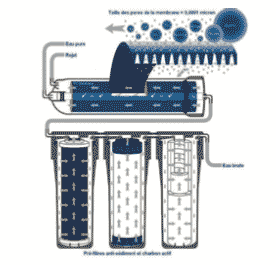
RO water is water filtered by a reverse osmosis system. The water passes through several filters before flowing through an osmotic membrane that will let only water molecules and the smallest minerals (calcium and magnesium) pass through.
RO water and health
Water's main role is to cleanse our bodies rather than provide us with minerals. The lower its particle content (TDS), the greater its cleansing “power.” RO water is therefore the best water for your health. For more information, download our guide: How to choose your drinking water?

RO water and aquariums
A reverse osmosis system gives you pure water, free of bacteria and other pollutants, making it perfect water for your fish. You will also be able to adjust your GH and KH easily.

RO water and pH
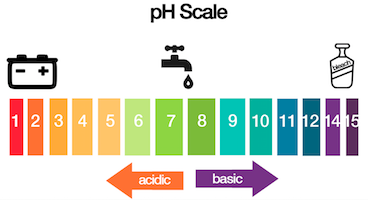
Because RO water has a very low mineral content, it has little or no mineral buffering. Very soft water allows pH to vary widely. The pH value can therefore be high or low and vary over time.
RO water and demineralized water
Unlike demineralized water, RO water still contains small amounts of minerals (calcium and magnesium). Demineralized water is not suitable for drinking because it does not conduct electricity.

RO water or spring water?
Good-quality bottled spring water is available with a dry residue level between 10 and 100 mg/L. Examples include Mont Roucous, Montcalm, and Rosée de la Reine. The downside is that it is expensive (0.40 €/L for Mont Roucous) and is not available everywhere.
How do you make RO water?
The best way to get RO water is to buy a reverse osmosis system. If you have decided to take the plunge and buy an RO system, but feel a little lost, follow our guide : How to choose your RO system?
"A reverse osmosis system is expensive." Not anymore!
Through josmose.fr, our company has made it its mission to make home RO systems accessible so that everyone can have one. That is why, while market leaders line their pockets by offering reverse osmosis systems for between 1,000 and 2,000 euros, we offer equivalent models for between 230 and 900 euros (we refer you to the article "How to choose your home RO system?" to understand the differences). How do we do it, you may ask? There are 3 reasons for our low prices:
- Buying directly from the source
While our competitors buy their equipment from European wholesalers who buy from Taiwanese wholesalers,who in turn source it from factories in Asia, we have done extensive sourcing work to work directly with manufacturers and get the best possible value for money.
- A small company
We have no salespeople roaming the streets of France to sell RO systems. There are just 2 of us, both engineers, running our business, and we optimize all development costs to be as competitive as possible.
- Low margins

At josmose.fr, excessive margins are out of the question. Of course, we need to make a living and are gradually starting to pay ourselves, but our primary goal is to reach as many health-conscious consumers as possible, regardless of their purchasing power.
That is why our prices are 2 to 4 times lower than the market leader's, for products of equivalent or even better quality.
How much does RO water cost ?
Let's do a little math together... We said that one of our home RO systems costs between 230 and 900 euros to buy. What about consumables? Depending on the RO system model you choose, filters, filter cartridges, and membranes will cost you between 70 and 270 euros per 2-year cycle, thanks to the discounted complete kits we offer.
So, if we spread the cost of your reverse osmosis system over 10 years, assume a water cost of 3.75 euros per cubic meter and daily consumption of 10 liters of water per household, we get the following figures:
- Least expensive RO system: 230/10 + 75/2 + 10x365x3x3.75/1,000 = 101.5 euros per year, or 8.4 per month or 28 cents per day
- Most expensive RO system: 900/10 + 270/2 + 10x365x3x3.75/1,000 = 266 euros per year, or 22 per month or 72 cents per day
Now let's compare this with half as much consumption, but using bottled water:
- Least expensive water (Cristaline, with quality that varies widely depending on the source): 1.03/9x5x365 = 209 euros per year, or 35 euros per month or 1.15 euro per day
- Best water (Mont Roucous, recommended for infants and pregnant women): 2.76/9x5x365 = 560 euros per year, or 56 euros per month or 1.53 euro per day
We are not taking into account transportation costs to buy your water, or the significant environmental impact of plastic bottles!
You can therefore see that drinking RO water, beyond its health and environmental benefits, allows you to reduce your drinking water budget by a factor of 2 to 6.
To sum up...
RO water is not free, but our efforts have considerably reduced its cost to consumers. Drinking water produced by a home RO system is now 2 to 6 times less expensive, and infinitely better for the environment, than drinking bottled water.
Spread the word by sharing this article.
- Published on
- REVERSE OSMOSIS,
- FILTERING YOUR DRINKING WATER
Related products
Related blog posts
>-

Understanding Bottled Water
Excessive mineral content, failure to meet standards,...
-

Why Should You Avoid Drinking Salt-Softened Water?
The effects of softened water on your health, your...
-

Reverse Osmosis Also Purifies Water in Belgium
After months of research, we discovered that our...
-

A Reverse Osmosis System—What's That ???
What is a reverse osmosis system? Today, we see and...
-

How to Choose Your Home RO System: Pure or Mineral Water?
Explore the differences between models to choose the...
-

What Water Should You Drink? Video Lecture by Chemist Marc Henry
A chemist who has worked extensively in the field of...
-

Poison in Tap Water
This France 3 report dates from 2010 and was...
-

Can Your Body Absorb Minerals in Drinking Water?
For mineral water producers, the answer is clearly a...
-

Humans and Water: A Complete Article on the Role of Water in Human Life
How closely are humans connected to water ? When and...
-

Municipal Water and Nanoscale Particles
Nanotechnology has its downsides...
-

Should You Filter Tap Water in France?
After this broad overview (see previous articles), the...
-

Medications in Drinking Water
The presence of medications in drinking water in...
-

The “Cocktail” Effect
The “cocktail” effect has nothing to do with...
-

The Water Situation in France
The water situation in France is barely any brighter...
-
Understanding Bottled Water
Excessive mineral content, failure to meet standards,...
-
Why Should You Avoid Drinking Salt-Softened Water?
The effects of softened water on your health, your...
-
Reverse Osmosis Also Purifies Water in Belgium
After months of research, we discovered that our...
-
A Reverse Osmosis System—What's That ???
What is a reverse osmosis system? Today, we see and...
-
How to Choose Your Home RO System: Pure or Mineral Water?
Explore the differences between models to choose the...
-
What Water Should You Drink? Video Lecture by Chemist Marc Henry
A chemist who has worked extensively in the field of...
-
Poison in Tap Water
This France 3 report dates from 2010 and was...
-
Can Your Body Absorb Minerals in Drinking Water?
For mineral water producers, the answer is clearly a...
-
Humans and Water: A Complete Article on the Role of Water in Human Life
How closely are humans connected to water ? When and...
-
Municipal Water and Nanoscale Particles
Nanotechnology has its downsides...
-
Should You Filter Tap Water in France?
After this broad overview (see previous articles), the...
-
Medications in Drinking Water
The presence of medications in drinking water in...
-
The “Cocktail” Effect
The “cocktail” effect has nothing to do with...
-
The Water Situation in France
The water situation in France is barely any brighter...