


Recherche dans le blog
Scientific Articles
- A few figures?
- Why drink water?
- When should you drink water?
- How much water should you drink each day?
- Signs of dehydration
- Qualities required for good drinking water
Why Should You Avoid Drinking Softened Water?
- The reason given by the WHO
- Further details on water softeners
- Maintenance considerations
- An alternative to conventional salt-based water softeners
Should You Filter Tap Water in France?
- The official answer: No, water filtration is not necessary
- According to scientists: Yes, purifying your drinking water is essential
Can Your Body Absorb the Minerals in Drinking Water?
- An interesting study in Germany
- What does the WHO think?
- Water for dummies
- The study results
- The minerals in water are not bioavailable
- Other drawbacks of mineral water
A Closer Look at Dry Residue in Water
- Drinking water: a luxury in France?!?
- Pesticides and other little gifts in tap water
- As with VW, the levels change, but the nature stays the same...
- Another major problem: water chlorination!
- Are we drinking medicated water?!?
- What goes unnoticed in health safety tests...
- ...but not under scientists' scrutiny, as they even find heroin in tap water
- Laboratories' conflict of interest
Drinking Water Around the World
Beware of Natural Water Sources!
- Double standards…
- Bottled waters have very different mineral levels
- A few unexplained peculiarities
- The case of Cristaline water
- Thermal waters
- Beware of minerals!
- And where does soda fit into all this?
How to Read Your Mineral Water Label
- Dry residue
- Anions/cations
- Calcium
- Magnesium
- Sodium
- Potassium
- Bicarbonate
- Chloride
- Sulfate
- Nitrate
- The bioavailability of minerals in water
Municipal Water and Nanoscale Particles
Aluminum in Water Doubles the Risk of Developing Alzheimer's Disease
- A danger worse than asbestos
- Tap water, a cocktail of chemical medications
- What the « official recommendations » don't say
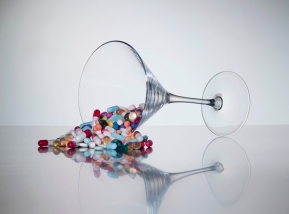
The “Cocktail” Effect
Certain chemicals consumed individually by humans and thought to be harmless at low doses suddenly become harmful when mixed with others.
A true potentiation occurs between the molecules, meaning a multiplication of toxic side effects.
A perfect example was discussed in our previous article : the pesticide Roundup from the infamous company Monsanto. Indeed, formulated pesticide products as sold to gardeners and farmers are 2 to 1,000 times more toxic than the active ingredients alone tested in vivo over the medium and long term.
Scientists have long suspected the harmful potential of the “cocktail” effect, which calls all of toxicology into question.
This becomes concerning when you count the dozens of known and unknown molecules present in trace amounts in drinking water and even in bottled water.
We need to take a comprehensive view of the various pollutants in water, rather than looking at them individually as is currently the case.
Did you know that nearly 900 chemical molecules, virtually all of them toxic, are approved in France and Europe, and that they may end up or are already present in our groundwater ? Even in trace amounts, below official thresholds, what happens to all these molecules when they combine with one another and trigger chemical reactions ?
You are free to accept or decline this cocktail offered by a stranger…
To avoid this “cocktail” effect, choose reverse osmosis, which will spare you all the problems associated with this mixture of chemical molecules.
Source : “How to Purify and Revitalize Your Drinking Water” by Richard Haas :
A former healthcare professional specializing in aqueous injectable solutions who spent years researching water using Vincent's bioelectronics (BEV).
- Published on
- Scientific Articles
Related blog posts
>-

Beware of Natural Water Sources!
We reviewed the 3 main alternative sources of drinking...
-

Should You Filter Tap Water in France?
After this broad overview (see previous articles), the...
-

Medications in Drinking Water
The presence of medications in drinking water in...
-

The Water Situation in France
The water situation in France is barely any brighter...
-

Drinking Water Around the World
An article reporting on the drinking water situation...
-
Beware of Natural Water Sources!
We reviewed the 3 main alternative sources of drinking...
-
Should You Filter Tap Water in France?
After this broad overview (see previous articles), the...
-
Medications in Drinking Water
The presence of medications in drinking water in...
-
The Water Situation in France
The water situation in France is barely any brighter...
-
Drinking Water Around the World
An article reporting on the drinking water situation...