Recherche dans le blog
Featured Articles
Articles in the category "Featured Articles"
What Is TDS?
TDS in water: definition, measurement, interpretation, and limitations
TDS, short for Total Dissolved Solids, refers to the total amount of substances dissolved in water. It is a useful indicator for tracking the mineral content of water or checking the operation of a reverse osmosis system (RO system), but it cannot precisely identify the substances present.
Updated on September 11, 2026, by the Josmose team.
TDS: what does it mean?
TDS indicates the overall amount of dissolved solids in water, usually expressed in ppm or mg/L. A high value means the water contains more dissolved ionic substances, but does not tell you which ones. Conversely, a low value alone does not guarantee the absence of contaminants.

What is TDS in water?
The term TDS stands for Total Dissolved Solids, meaning “the total amount of dissolved solids.”
It represents the overall amount of dissolved substances present in water. These may include ions from:
- calcium;
- magnesium;
- sodium;
- bicarbonates;
- chlorides;
- sulfates;
- nitrates;
- and other dissolved ionic substances.
TDS is usually expressed in mg/L or ppm. In water, these two units are often used as approximately equivalent for routine measurements.
Understanding TDS in a video
How is TDS measured?
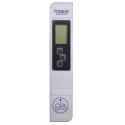
A TDS meter does not directly weigh all the substances present in water. It primarily measures the water’s electrical conductivity, then converts that measurement into a TDS estimate.
The more dissolved ions capable of conducting electricity water contains, the higher its conductivity — and therefore its estimated TDS value — tends to be.
This measurement is quick and very convenient for comparing:
- water before and after reverse osmosis;
- two different water sources;
- changes in an RO system’s performance over time.
What does a TDS meter actually measure?
A TDS meter measures an overall amount. It cannot identify each substance present individually.
| What TDS can indicate | What it cannot indicate |
|---|---|
| Overall level of dissolved ionic substances | Which specific contaminants are present |
| Changes in mineral content | Presence or absence of PFAS |
| Difference before / after reverse osmosis | Presence of specific pesticides |
| Useful indicator for monitoring an RO system | Presence of bacteria or viruses |
High TDS does not necessarily mean the water is polluted
Water can have a high TDS value simply because it contains a lot of natural minerals. Conversely, water with low TDS may contain a small amount of a contaminant that a simple TDS meter cannot identify. TDS should therefore be interpreted as an indicator of the overall amount, rather than a comprehensive test of water safety.
How do you interpret a TDS value?
There is no single TDS value that, on its own, tells you whether water is “good” or “bad.”
A value should always be interpreted based on:
- the water’s source;
- its mineral composition;
- its intended use;
- the treatment applied;
- and, if necessary, more specific analyses.
For example, naturally mineral-rich water can have a relatively high TDS without automatically containing more pollutants.
TDS in different types of water
Values can vary considerably. The following table should be understood as a rough guide, rather than a drinking water standard.
| Type of water | Commonly observed TDS | Note |
|---|---|---|
| RO water | Generally low | Depends on the incoming TDS and the membrane’s retention rate |
| Tap water | Highly variable | Depends heavily on the region and water source |
| Bottled water | Highly variable | Some waters have very low mineral content, while others are very rich in minerals |
| Well water | Variable | A comprehensive analysis is preferable to determine its composition |
| Softened water | Not necessarily lower | A water softener primarily exchanges calcium and magnesium for other ions |
How does TDS help you check an RO system?
TDS is particularly useful for monitoring the performance of an RO system with a reverse osmosis membrane.
Simply compare:
- the TDS of the incoming water;
- the TDS of the RO water at the outlet.
This comparison lets you estimate the membrane’s apparent retention rate.
Calculation example
Incoming water: 400 ppm
RO water: 20 ppm
Estimated reduction rate: (400 - 20) ÷ 400 × 100 = 95 %
This calculation is useful for monitoring the membrane’s condition, but it still cannot tell you which specific substances have been reduced.
To understand the process: what is reverse osmosis?
How can you reduce TDS in water?
To significantly reduce TDS, you need a technology capable of removing a substantial portion of the dissolved substances.
Reverse osmosis (RO) is particularly well suited to this goal. Its membrane can significantly reduce the amount of dissolved salts and ions.
By contrast, a simple activated carbon filter can improve certain characteristics of water without necessarily causing a significant decrease in its TDS value.
TDS and water hardness: what is the difference?
TDS and hardness do not measure the same thing.
| Measurement | What it represents |
|---|---|
| TDS | Estimated total amount of dissolved ionic substances |
| Hardness | Primarily calcium and magnesium |
Water can therefore be relatively soft while still having high TDS, because other dissolved ions remain present.
Why doesn’t a water softener necessarily lower TDS?
A conventional water softener primarily works through ion exchange.
It removes some of the calcium and magnesium responsible for hardness and replaces them with other ions.
The overall amount of dissolved substances therefore does not necessarily decrease much. It is entirely possible for softened water to retain a TDS value similar to, or slightly different from, the value measured before treatment.
The limitations of a TDS measurement
TDS is a practical tool, but it does not replace a proper water analysis.
On its own, it cannot tell you whether the water contains:
- PFAS;
- a specific pesticide;
- pharmaceutical residues;
- microorganisms;
- a particular metal;
- a specific substance at a low concentration.
To test for a particular contaminant, you need an appropriate analytical method.
To learn more: explore our water analysis solutions .
Want to measure the TDS of your water?
A TDS meter lets you quickly compare your water’s mineral content before and after treatment.
View the TDS meterFrequently asked questions about TDS
What does TDS mean?
TDS stands for Total Dissolved Solids, meaning the total amount of dissolved solids. It is an estimate of the overall amount of ionic substances dissolved in water.
What is the right TDS level for drinking water?
TDS alone cannot determine whether water is safe to drink. A low or high value must be interpreted alongside the water’s actual composition and the applicable health criteria.
Does low TDS mean the water is pure?
No. Low TDS primarily means the water contains few dissolved ionic substances. It does not guarantee the absence of all contaminants or microorganisms.
Does high TDS mean the water is polluted?
Not necessarily. Water rich in natural minerals can have high TDS without automatically being polluted.
Does a TDS meter detect PFAS?
No. A TDS meter cannot identify the presence of PFAS. A specific analysis is needed to test for these substances.
Does a TDS meter detect pesticides?
No. It measures overall conductivity, then estimates the level of dissolved solids. It cannot identify a particular pesticide.
Why measure TDS before and after an RO system?
Comparing the two measurements lets you estimate the reduction in dissolved substances and monitor the membrane’s overall performance.
Does an increase in TDS after an RO system mean the membrane needs to be replaced?
A sustained increase can be a sign of declining performance, but it must be interpreted alongside the incoming TDS, pressure, temperature, and manufacturer’s recommendations. A single measurement is not always enough to conclude that the membrane needs to be replaced.
What is the difference between TDS and hardness?
Hardness primarily concerns calcium and magnesium. TDS estimates a much broader range of dissolved ionic substances.
How often should you measure an RO system’s TDS?
There is no universal measurement schedule you need to follow. Periodic measurements and comparisons with the incoming value let you track changes in the system. You can adjust the frequency based on usage and the manufacturer’s recommendations.
Learn more
About this guide
This content is written by the Josmose team based on our experience with water treatment systems and TDS measurement.
TDS is a monitoring indicator and should not be treated as a comprehensive analysis of water safety.
Josmose sells RO systems, measuring devices, and products available through this page.
- Published on
- Featured Articles,
- REVERSE OSMOSIS
Related blog posts
>-

A Closer Look at Dry Residue in Water
The amount of dry residue in water is the amount of...
-

Why Should You Avoid Drinking Salt-Softened Water?
The effects of softened water on your health, your...
-

Why Does TDS Rise When Your RO System Is Idle?
If you have a reverse osmosis system with an LCD...
-

Why Does TDS Rise in the First CL of Water Produced?
Have you noticed that the TDS of the first water from...
-

Aluminum in Water Doubles the Risk of Developing Alzheimer's
Excerpt from an article by Rodolphe Bacquet,...
-

Poison in Tap Water
This France 3 report dates from 2010 and was...
-

Municipal Water and Nanoscale Particles
Nanotechnology has its downsides...
-

Should You Filter Tap Water in France?
After this broad overview (see previous articles), the...
-
A Closer Look at Dry Residue in Water
The amount of dry residue in water is the amount of...
-
Why Should You Avoid Drinking Salt-Softened Water?
The effects of softened water on your health, your...
-
Why Does TDS Rise When Your RO System Is Idle?
If you have a reverse osmosis system with an LCD...
-
Why Does TDS Rise in the First CL of Water Produced?
Have you noticed that the TDS of the first water from...
-
Aluminum in Water Doubles the Risk of Developing Alzheimer's
Excerpt from an article by Rodolphe Bacquet,...
-
Poison in Tap Water
This France 3 report dates from 2010 and was...
-
Municipal Water and Nanoscale Particles
Nanotechnology has its downsides...
-
Should You Filter Tap Water in France?
After this broad overview (see previous articles), the...