


Recherche dans le blog
REVERSE OSMOSIS
What Is a Reverse Osmosis System?
Vincent's Bioelectronics and Reverse Osmosis
Why Install a Reverse Osmosis System?
The Health Benefits of a Reverse Osmosis System
- A high-quality drink
- Water that is easy to drink
- More reasons
- Your kidneys will thank you
- More advantages of RO systems
Reverse Osmosis System: Pros and Cons
How to Choose a Home Reverse Osmosis System
- RO water definition
- RO water and health
- RO water and aquariums
- RO water and pH
- RO water and demineralized water
- RO water or spring water?
- How to make RO water
- "A RO system is expensive" - Not anymore!
- How much does RO water cost?
Frequently Asked Questions About RO Systems
- Why are prices so low?
- RO system installation
- Where?
- How much space?
- How long does it take?
- What tools?
- How do you drill a sink?
- How do you connect the water?
- How much does the whole system weigh?
- Home uses
- Baby bottles?
- Ice cubes?
- American-style fridge?
- Face and hair?
- Plants?
- Windshield washers?
- Heating appliances?
- Dishes?
- Windows?
- Maintenance
- Technology
- Advantage of the booster pump?
- Disadvantage of the booster pump?
- Benefit of quick connectors?
- Benefit of a UV sterilizer?
- Benefit of a TDS tester?
- What TDS level can you expect?
- Performance
How to Install a Reverse Osmosis System
Technical Explanations on Using RO Systems
- Why Does TDS Rise in the First Centiliters of Water Produced?
- Why Does TDS Rise When the RO System Is Idle?
- Why Does My Tank-Based RO System Sometimes Start and Sometimes Not?
- My RO System Produces Less Water: Why?
- How to Avoid Drilling Your Countertop
Reverse Osmosis System Maintenance
- What are Total Dissolved Solids (TDS)?
- Where do dissolved solids come from?
- Why measure the TDS level of your water?
A Reverse Osmosis System With No Wastewater?
- Why does a RO system produce wastewater?
- How to limit wastewater
- Wastewater-free technology: ultrafiltration
Looking for a Reverse Osmosis System Manufacturer?
Why Is the Reverse Osmosis System the Ideal Product in Africa?
Louis-Claude Vincent's Bioelectronics and Reverse Osmosis
A little history
A hydrology specialist and professor at the École d’anthropologie de Paris, Louis-Claude Vincent (1906-1988) said, " Life is the electronics of the water inside the human body ". He created bioelectronics, a highly effective method for determining the health of a living being and also for treating it. All of this is achieved by analyzing the physical and chemical parameters of the various fluids that make up your body and comparing them with standards for good health. However, although this method is highly effective, it is not officially used.
The different factors considered in BEV
Ph (magnetic factor)
It determines whether an environment is acidic or alkaline (basic), and its value ranges from 0 to 14. From 0 to 7, the environment is described as acidic, and at 7 it is neutral. Finally, between 7 and 14, the environment is described as alkaline.
rH2 (electrical factor)
It indicates the oxidation-reduction capabilities of the solution. The rH2 value ranges from 0 to 42, with 28 being the neutral state. From 0 to 28, the environment is described as reducing, and from 28 to 42, it is oxidizing.
The rH2 of drinking water
Water that is good to drink has a neutral rH2 or a value around 24-28. Above 32, the water encourages the development of viruses. Below 24, the water encourages the development of bacteria.
Electrical conductivity
The ions present in water increase its electrical conductivity, meaning that electric current passes through it more easily. The unit used to measure conductivity is the microsiemens (µS), so the more concentrated a solution is in minerals, the higher its conductivity, and vice versa.
Vincent's energy quantification " W "
W represents energy expressed in microwatts per cm³. In the human body, " W " represents energy stored in the blood, saliva, and urine. Several scientists agree that a low " W " value is synonymous with quality in the water and food you consume. In all living beings, " W " must be as low as possible.
The four terrains
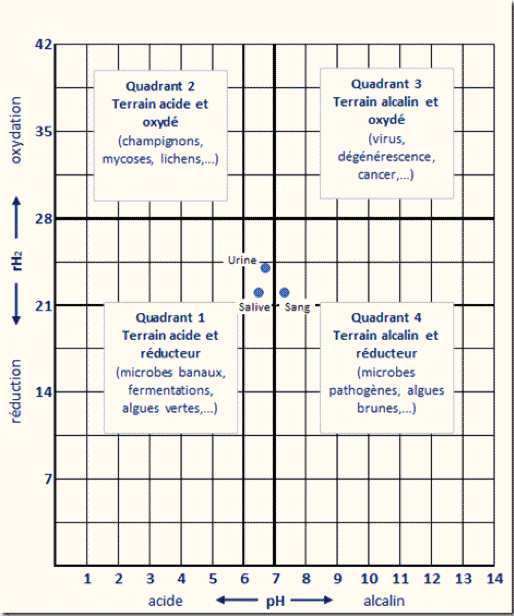
The biological terrain represents your body's ability to defend itself against disease. The terrain consists of all the organic fluids in your body.
1st region : acidic and reducing environment (vitality)
This is the environment known as " life ". It encourages the development of green algae and common microbes. Foods in this zone are good from a vitality perspective. Good-quality drinking water is also found here. It is a regenerating environment.
2nd region : acidic and oxidized environment (preservation)
This environment encourages the development of fungi. It contains foods that do not promote vitality, such as industrially produced foods and fast food.
3rd region : alkaline and reducing environment (destruction)
This environment encourages the development of pathogenic microbes and brown algae. It is the environment of putrefaction.
4th region : alkaline and oxidized environment (degradation)
This environment encourages the development of viruses. It contains everything sweet, as well as tap water. It is the living environment of modern humans.
- Published on
- REVERSE OSMOSIS
Related products
Related blog posts
>-

The Health Benefits of an RO System
An RO system offers various benefits for your health....
-

What Water Should You Drink? Video Lecture by Chemist Marc Henry
A chemist who has worked extensively in the field of...
-
The Health Benefits of an RO System
An RO system offers various benefits for your health....
-
What Water Should You Drink? Video Lecture by Chemist Marc Henry
A chemist who has worked extensively in the field of...