


Recherche dans le blog
REVERSE OSMOSIS
What Is a Reverse Osmosis System?
Vincent's Bioelectronics and Reverse Osmosis
Why Install a Reverse Osmosis System?
The Health Benefits of a Reverse Osmosis System
- A high-quality drink
- Water that is easy to drink
- More reasons
- Your kidneys will thank you
- More advantages of RO systems
Reverse Osmosis System: Pros and Cons
How to Choose a Home Reverse Osmosis System
- RO water definition
- RO water and health
- RO water and aquariums
- RO water and pH
- RO water and demineralized water
- RO water or spring water?
- How to make RO water
- "A RO system is expensive" - Not anymore!
- How much does RO water cost?
Frequently Asked Questions About RO Systems
- Why are prices so low?
- RO system installation
- Where?
- How much space?
- How long does it take?
- What tools?
- How do you drill a sink?
- How do you connect the water?
- How much does the whole system weigh?
- Home uses
- Baby bottles?
- Ice cubes?
- American-style fridge?
- Face and hair?
- Plants?
- Windshield washers?
- Heating appliances?
- Dishes?
- Windows?
- Maintenance
- Technology
- Advantage of the booster pump?
- Disadvantage of the booster pump?
- Benefit of quick connectors?
- Benefit of a UV sterilizer?
- Benefit of a TDS tester?
- What TDS level can you expect?
- Performance
How to Install a Reverse Osmosis System
Technical Explanations on Using RO Systems
- Why Does TDS Rise in the First Centiliters of Water Produced?
- Why Does TDS Rise When the RO System Is Idle?
- Why Does My Tank-Based RO System Sometimes Start and Sometimes Not?
- My RO System Produces Less Water: Why?
- How to Avoid Drilling Your Countertop
Reverse Osmosis System Maintenance
- What are Total Dissolved Solids (TDS)?
- Where do dissolved solids come from?
- Why measure the TDS level of your water?
A Reverse Osmosis System With No Wastewater?
- Why does a RO system produce wastewater?
- How to limit wastewater
- Wastewater-free technology: ultrafiltration
Looking for a Reverse Osmosis System Manufacturer?
Why Is the Reverse Osmosis System the Ideal Product in Africa?
How to Avoid Drilling Into Your Countertop
By default, our RO systems come with an additional faucet that is traditionally installed on your sink, often requiring you to drill into your countertop.
This is not very complicated with the right tools, and most of our customers do it themselves without any hesitation. However, we also consider those who choose otherwise for various reasons:
- Not enough space to install a second faucet
- A rental agreement that prohibits any changes to the kitchen layout
- No drill available
- Or simply no desire to tackle this kind of DIY project
Whatever your reason, we have a solution for you: a 3-way faucet!
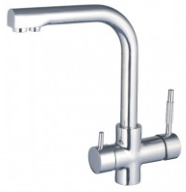
This mixer faucet is called “3-way” for a simple reason: it has 3 flexible hoses and 2 outlets so you can have cold water, hot water, and RO water all in one place. This accessory has a standard diameter and replaces your current kitchen faucet.
Of course, these 3-way mixer faucets are high quality, which means an additional cost. But your investment remains extremely cost-effective compared with what you spend on bottled water each year.
Installation is very easy. Connect the 2 standard flexible hoses to your hot and cold water supplies (as you would with a regular faucet), and the third to the blue tubing on your RO system (RO water).
- Published on
- REVERSE OSMOSIS
Related products
Related blog posts
>-

An RO System Without Wastewater?
Is there an RO system without wastewater? Why does an...
-

A Reverse Osmosis System—What's That ???
What is a reverse osmosis system? Today, we see and...
-

How to Choose Your Home RO System: Pure or Mineral Water?
Explore the differences between models to choose the...
-
An RO System Without Wastewater?
Is there an RO system without wastewater? Why does an...
-
A Reverse Osmosis System—What's That ???
What is a reverse osmosis system? Today, we see and...
-
How to Choose Your Home RO System: Pure or Mineral Water?
Explore the differences between models to choose the...