


Recherche dans le blog
REVERSE OSMOSIS
What Is a Reverse Osmosis System?
Vincent's Bioelectronics and Reverse Osmosis
Why Install a Reverse Osmosis System?
The Health Benefits of a Reverse Osmosis System
- A high-quality drink
- Water that is easy to drink
- More reasons
- Your kidneys will thank you
- More advantages of RO systems
Reverse Osmosis System: Pros and Cons
How to Choose a Home Reverse Osmosis System
- RO water definition
- RO water and health
- RO water and aquariums
- RO water and pH
- RO water and demineralized water
- RO water or spring water?
- How to make RO water
- "A RO system is expensive" - Not anymore!
- How much does RO water cost?
Frequently Asked Questions About RO Systems
- Why are prices so low?
- RO system installation
- Where?
- How much space?
- How long does it take?
- What tools?
- How do you drill a sink?
- How do you connect the water?
- How much does the whole system weigh?
- Home uses
- Baby bottles?
- Ice cubes?
- American-style fridge?
- Face and hair?
- Plants?
- Windshield washers?
- Heating appliances?
- Dishes?
- Windows?
- Maintenance
- Technology
- Advantage of the booster pump?
- Disadvantage of the booster pump?
- Benefit of quick connectors?
- Benefit of a UV sterilizer?
- Benefit of a TDS tester?
- What TDS level can you expect?
- Performance
How to Install a Reverse Osmosis System
Technical Explanations on Using RO Systems
- Why Does TDS Rise in the First Centiliters of Water Produced?
- Why Does TDS Rise When the RO System Is Idle?
- Why Does My Tank-Based RO System Sometimes Start and Sometimes Not?
- My RO System Produces Less Water: Why?
- How to Avoid Drilling Your Countertop
Reverse Osmosis System Maintenance
- What are Total Dissolved Solids (TDS)?
- Where do dissolved solids come from?
- Why measure the TDS level of your water?
A Reverse Osmosis System With No Wastewater?
- Why does a RO system produce wastewater?
- How to limit wastewater
- Wastewater-free technology: ultrafiltration
Looking for a Reverse Osmosis System Manufacturer?
Why Is the Reverse Osmosis System the Ideal Product in Africa?
Why Does TDS Rise When Your RO System Is Idle?
A reminder: TDS (Total Dissolved Solids) measures the amount of dry residue in a liquid. It is particularly useful for checking the effectiveness of a filtration system, especially a reverse osmosis system designed to remove as many impurities from the water as possible.
If you have a reverse osmosis system with an LCD screen, you have probably noticed that when the pump is off, the TDS displayed on the screen gradually rises, sometimes exceeding 100PPM.
This phenomenon is completely normal: it is natural osmosis.
Here is how it works: osmosis balances the concentration and pressure of two solutions separated by a semipermeable membrane, which means that it allows only the liquid through, but not the solids. If you pour an almost pure liquid into one side of a U-shaped tube fitted with this type of membrane and a highly concentrated liquid into the other, the level on the side with the lower concentration will naturally fall as the level on the side with the higher concentration rises.
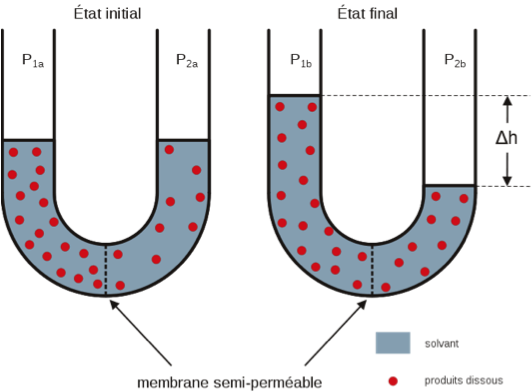
A reverse osmosis system uses the opposite phenomenon by applying pressure on one side of the membrane to force the mineral concentrations as far apart as possible. This makes it possible to obtain almost pure RO water and drain water with a very high concentration of impurities.
However, when the pump is not running and the pressure balances on both sides of the RO membrane, the mineral concentrations also tend to balance, which is why TDS rises. There is no need to worry: this high TDS affects only the first few cl of water at your RO system's outlet. You will see TDS drop quickly as soon as the pump starts running again.
For more information about reverse osmosis systems, contact us at 09.72.55.18.50 or through the contact form.
- Published on
- REVERSE OSMOSIS
Related products
Related blog posts
>-

How to Choose Your Home RO System: Pure or Mineral Water?
Explore the differences between models to choose the...
-

Why Is My RO System Producing Less Water?
After an RO system has been running for a while, if it...
-

Frequently Asked Questions About RO Systems
All the questions our customers have asked by email,...
-
How to Choose Your Home RO System: Pure or Mineral Water?
Explore the differences between models to choose the...
-
Why Is My RO System Producing Less Water?
After an RO system has been running for a while, if it...
-
Frequently Asked Questions About RO Systems
All the questions our customers have asked by email,...