


Recherche dans le blog
What Water Should You Drink? Video Lecture by Chemist Marc Henry
In this 2013 lecture, chemist Marc Henry shows us that our bodies are made up of nearly 70 % water by weight, and 99 % by number of molecules. The aim is to make us aware of the importance of water to balance in our lives ; and more specifically of its role : removing toxins from the body.
In a highly scientific discussion, he also presents the various molecules essential to life.
He then defines the different types of water :
—> Tap water
—> Filtered water
—> Spring water
—> Natural mineral water
Marc Henry presents a strong argument against bottled water. He states that only 12 % of water bottles are recycled, which is a huge source of pollution.
An overview of the water market reveals the battle between Nestlé and Danone, as well as the disruptive Groupe Castel, which manages to come out ahead. He also names a few independent producers, such as “ Mont Roucous ”, which offers quality water, unlike the vast majority of brands.
As a chemist, Mr. Henry advises consumers on choosing “ good ” water. In particular, he recommends checking the dry residue, which appears on bottles as : Total mineral content (dry residue), in ppm or mg/L. Water below 100 mg/L is water that cleanses us, good water. Look at the water bottles you buy at the supermarket, and you will be very surprised !
What about water pH ?
Should you drink acidic, neutral, or alkaline water ?
According to Mr. Henry, water acidity clearly has no value, but other BEV experts recommend a pH between 6 and 7, meaning slightly acidic.
What about electrons ?
Professor Henry, along with all BEV experts, recommends drinking water with an rH2 between 25 and 28, and above all a resistivity greater than 6,000 ohms.
Water oxidation is largely due to chlorine, which removes bacteria and viruses, BUT it promotes the development of cancers and other diseases such as thrombosis over the long term. You therefore need to remove both pathogens AND chlorine from your tap water, and the best way to do this is to use a reverse osmosis system.
The 5 best waters according to this chemistry professor are :
- RO water : the best water to drink every day
- Mont Roucous : https://www.mont-roucous.com/eau-tres-faiblement-mineralisee/eau-mont-roucous/composition-mont-roucous
- Montcalm : http://www.montcalm.fr/la-composition/
- Volvic : which nevertheless has a resistivity 5 times lower than RO water, and an rH2 > 28… All other major brands are not recommended !
Mr. Henry then presents numerous scientific concepts related to water in medicines.
He then lists the reasons for not drinking tap water :
- The taste of tap water, particularly due to chlorine
- Nitrates, which are dangerous for infants and pregnant women
- Heavy metals (see the France3 report : Poison in water)
- Plant protection products : herbicides, insecticides, fungicides
- Pharmaceutical residues
Next come the questions surrounding water filtration.
After dismissing filter pitchers, which let nitrates and heavy metals pass through, Mr. Henry presents the solution in these terms.
1h20mn —> “ For those who want to be sure, there is a device called a reverse osmosis system, something that only lets water through ! ”
He nevertheless stresses the importance of properly replacing your RO membranes, and filters to keep the system effective over the long term.
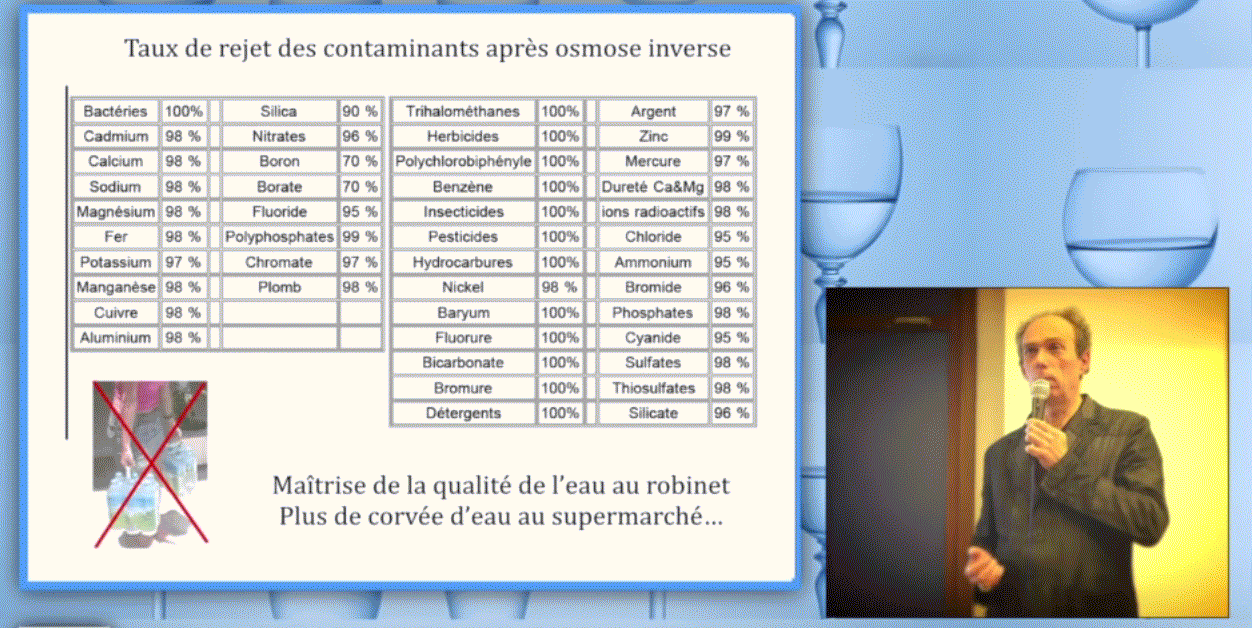
Home reverse osmosis systems enable you to drink tap water after filtering out all its particles, as shown in the table below from Mr. Henry's presentation. For more information about reverse osmosis systems, explore our guide :
How to choose your reverse osmosis system
Mr. Henry concludes with the concept of water dynamization, which involves restoring water's vital energy by recreating its natural movement. All you need to do is pass it through a vortex. These devices are sold in various forms, each more expensive than the last. At josmose.fr, we choose to show you how to do it yourself very easily : http://www.lejardindekiran.com/apprivoiser-une-tornade-ou-comment-creer-un-vortex-en-bouteille/
Related blog posts
>-

Understanding Bottled Water
Excessive mineral content, failure to meet standards,...
-

Why Should You Avoid Drinking Salt-Softened Water?
The effects of softened water on your health, your...
-

Reverse Osmosis System: For or Against?
What are the advantages and disadvantages of an RO...
-

A Reverse Osmosis System—What's That ???
What is a reverse osmosis system? Today, we see and...
-

How to Choose Your Home RO System: Pure or Mineral Water?
Explore the differences between models to choose the...
-

Poison in Tap Water
This France 3 report dates from 2010 and was...
-

Synthetic Ionized Alkaline Reduced Water (EIAR)
After a rapid surge in sales of these devices, sales...
-

Beware of Natural Water Sources!
We reviewed the 3 main alternative sources of drinking...
-

Medications in Drinking Water
The presence of medications in drinking water in...
-

The Water Situation in France
The water situation in France is barely any brighter...
-
Understanding Bottled Water
Excessive mineral content, failure to meet standards,...
-
Why Should You Avoid Drinking Salt-Softened Water?
The effects of softened water on your health, your...
-
Reverse Osmosis System: For or Against?
What are the advantages and disadvantages of an RO...
-
A Reverse Osmosis System—What's That ???
What is a reverse osmosis system? Today, we see and...
-
How to Choose Your Home RO System: Pure or Mineral Water?
Explore the differences between models to choose the...
-
Poison in Tap Water
This France 3 report dates from 2010 and was...
-
Synthetic Ionized Alkaline Reduced Water (EIAR)
After a rapid surge in sales of these devices, sales...
-
Beware of Natural Water Sources!
We reviewed the 3 main alternative sources of drinking...
-
Medications in Drinking Water
The presence of medications in drinking water in...
-
The Water Situation in France
The water situation in France is barely any brighter...