


Recherche dans le blog
REVERSE OSMOSIS
What Is a Reverse Osmosis System?
Vincent's Bioelectronics and Reverse Osmosis
Why Install a Reverse Osmosis System?
The Health Benefits of a Reverse Osmosis System
- A high-quality drink
- Water that is easy to drink
- More reasons
- Your kidneys will thank you
- More advantages of RO systems
Reverse Osmosis System: Pros and Cons
How to Choose a Home Reverse Osmosis System
- RO water definition
- RO water and health
- RO water and aquariums
- RO water and pH
- RO water and demineralized water
- RO water or spring water?
- How to make RO water
- "A RO system is expensive" - Not anymore!
- How much does RO water cost?
Frequently Asked Questions About RO Systems
- Why are prices so low?
- RO system installation
- Where?
- How much space?
- How long does it take?
- What tools?
- How do you drill a sink?
- How do you connect the water?
- How much does the whole system weigh?
- Home uses
- Baby bottles?
- Ice cubes?
- American-style fridge?
- Face and hair?
- Plants?
- Windshield washers?
- Heating appliances?
- Dishes?
- Windows?
- Maintenance
- Technology
- Advantage of the booster pump?
- Disadvantage of the booster pump?
- Benefit of quick connectors?
- Benefit of a UV sterilizer?
- Benefit of a TDS tester?
- What TDS level can you expect?
- Performance
How to Install a Reverse Osmosis System
Technical Explanations on Using RO Systems
- Why Does TDS Rise in the First Centiliters of Water Produced?
- Why Does TDS Rise When the RO System Is Idle?
- Why Does My Tank-Based RO System Sometimes Start and Sometimes Not?
- My RO System Produces Less Water: Why?
- How to Avoid Drilling Your Countertop
Reverse Osmosis System Maintenance
- What are Total Dissolved Solids (TDS)?
- Where do dissolved solids come from?
- Why measure the TDS level of your water?
A Reverse Osmosis System With No Wastewater?
- Why does a RO system produce wastewater?
- How to limit wastewater
- Wastewater-free technology: ultrafiltration
Looking for a Reverse Osmosis System Manufacturer?
Why Is the Reverse Osmosis System the Ideal Product in Africa?
Perchlorate in Municipal Water Supplies
Introduction
In a statement dated September 13, 2019, the “MEL,” or “métropole européenne de Lille,” strongly recommended no longer using tap water in bottles for newborns and infants under 6 months of age. Pregnant women are also advised against drinking water from the municipal supply. These recommendations are to apply from September 17, 2019, until further notice.
The reason for this restriction is a considerable increase in the concentration of perchlorate in the water supplied by the MEL's distribution networks. This sudden increase is linked to the use of new wells located in the southern part of the metropolitan area. This decision was necessary because three consecutive years of drought had lowered groundwater levels to an unprecedented low. These wells supply water with a perchlorate concentration greater than four micrograms per liter. Based on the ANSES opinions of July 18, 2011, and July 20, 2012, the Direction Générale de la Santé requested, as a precautionary measure, that restrictions on consumption be imposed:
- at perchlorate levels of 4 μg/L or higher for infants under 6 months of age
- above perchlorate levels of 15μg/L for pregnant and breastfeeding women (thereby protecting fetuses and infants).
Currently, the MEL estimates that approximately 90 municipalities are potentially affected by this perchlorate contamination.
This is not the first time that northern France has faced problems related to ammonium perchlorate in the municipal water supply. In October 2011, a study launched by the ARS (agence régionale de la santé) aimed to determine the concentration of perchlorate in municipal water supplies. In October 2012, this study revealed that 544 municipalities in the Nord and Pas-de-Calais departments were subject to an order restricting water consumption for infants under 6 months of age and for pregnant or breastfeeding women. Today, most of these municipalities are still affected by this problem.
The high concentrations of ammonium perchlorate in the Nord department are reportedly a legacy of World War I. According to the ARS, the countless munitions fired along the front line (which lay at the boundary between the Flandres plain and the Artois plateau) are believed to be responsible for the current perchlorate contamination of the water.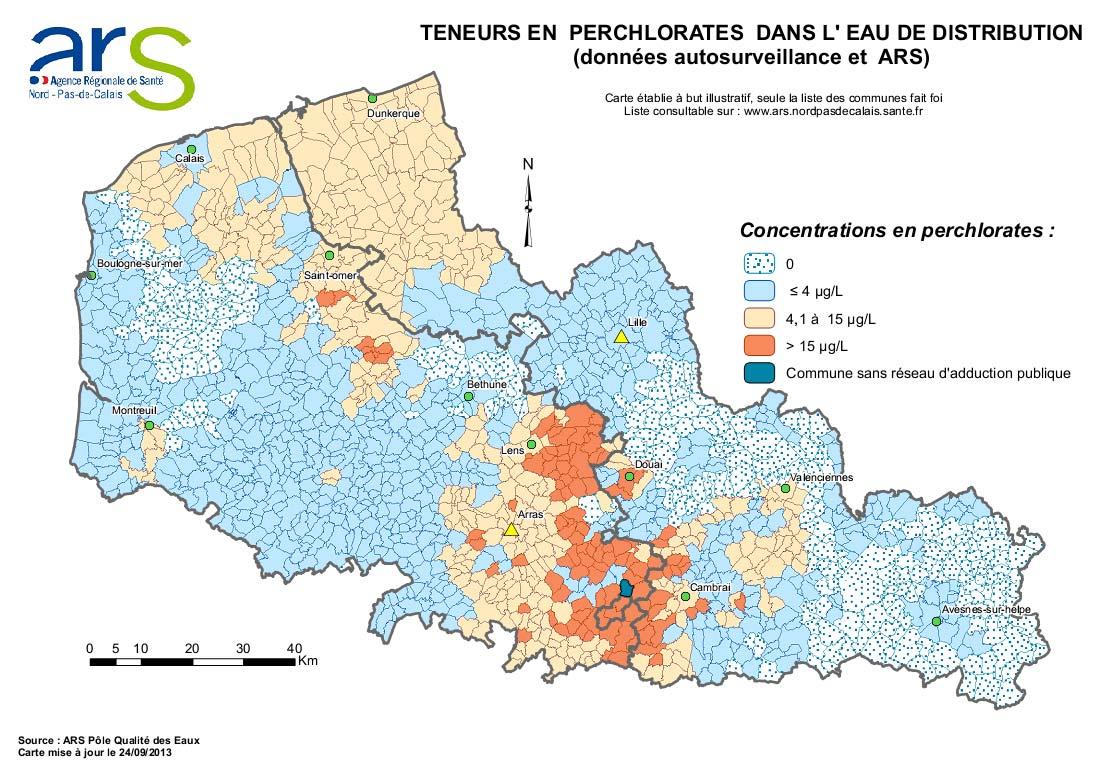
Map 1: ARS map showing perchlorate levels in the Nord-Pas de Calais region
How does ammonium perchlorate end up in the municipal water supply?
The presence of perchlorate in our municipal water supplies is explained by its chemical nature. This inorganic compound, of human or natural origin, is most commonly found as ammonium perchlorate NH4ClO4.
With the exception of heavy alkali metal perchlorates and a few large cations such as nitron and tetraphenylarsonium chloride (both used as gravimetric precipitants for perchlorate), all perchlorates are soluble in water.
After hydrolysis, perchlorate salts (ammonium, magnesium, calcium, cesium, barium, etc.) therefore dissolve completely in water to produce perchlorate in its anionic form: ClO4-. This form is highly mobile and is both colorless and odorless. Perchlorate can thus easily be carried down into groundwater. However, these contaminated water resources are used to supply our water distribution networks. This type of contamination is found in several regions of mainland France.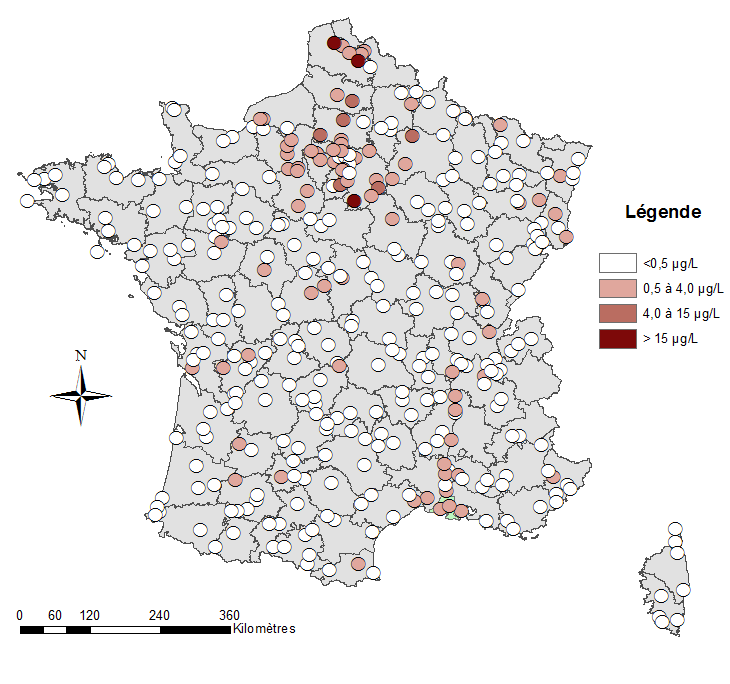
Map 2: Map of perchlorate ion levels in metropolitan France by concentration range (in μg/l) at raw water abstraction points, measured using grab samples during the sampling campaign conducted between October 2011 and May 2012 by the ANSES laboratoire d’hydrologie de Nancy (LHN)
What impact does perchlorate have on the human body?
Ingested perchlorate can cause many symptoms. Its toxicity affects various metabolic processes and organs. The main organ affected is the thyroid.
The thyroid, also called the mood gland, is the organ most affected by perchlorate absorption. Perchlorate enters the bloodstream through the gastrointestinal tract. Peak plasma levels are observed 3 hours after ingestion. Systemic perchlorate spreads through the body and concentrates mainly in the gastric mucosa, salivary gland, and thyroid. This causes thyroid dysfunction, specifically tending toward hypothyroidism. Perchlorate prevents thyroid cells from taking up iodide and also causes iodide to move out of these cells into the circulation through active transport (competition with iodine++). Since the perchlorate ion is not metabolized, it is then excreted by the kidneys. This competitive process affects the thyroid, even at low concentrations, after 14 days. Infants under six months of age, pregnant women, and fetuses are more sensitive to it than the rest of the population. Because their iodine reserves are lower, the thyroid hormone deficiency is greater and can affect their neurobehavioral development.
At higher concentrations (> 1g/day), effects on other organs are observed. Since perchlorate tends to concentrate in the gastric mucosa, it is not surprising to observe digestive disorders such as nausea, vomiting, and stomach pain.
From a hematological perspective, cases of anemia have been described, along with cases of agranulocytosis and leukopenia. Deaths have been reported in patients who developed bone marrow aplasia.
What are the solutions?
The simplest solution would be to comply with water use restrictions, although the Nord department is still experiencing drought conditions. These restrictions could help bring about a faster return to normal.
However, other solutions exist for local authorities. The ARS points out that "perchlorate treatment using ion exchange resins or membrane processes such as reverse osmosis may be considered to reduce perchlorate levels at the faucet". In the case of reverse osmosis, experiments show that approximately 80% of the initial perchlorate concentration (100 μg/L) in pure water could be removed. This removal rate can be improved by adding a cationic surfactant. Membrane filtration technologies show promise for removing perchlorate from drinking water.
Activated carbon filtration is also effective, but it is limited by the need to replace these filters very regularly. However, this method is often used upstream of reverse osmosis to remove chlorine and organic particles (tastes and odors).
Dr. Clément Parmentier
Sources
INERIS. Technical and economic data on chemical substances in France: ammonium perchlorate. DRS-12-126866-07629A, -67. 2012
Sanderson, R. T., "Inorganic Chemistry,"Reinhold, New York, 1967, p.83.
Lamm SH, Braverman LE, Li FX, Richman K, Pino S, Howearth G. Thyroid health status of ammonium perchlorate workers: a cross-sectional occupational health study. J Occup Environ Med 1999 ; 41 : 248-60.
https://france3-regions.francetvinfo.fr/hauts-de-france/nord-0/lille-metropole/cinq-questions-perchlorate-ce-residu-qui-pollue-eau-du-robinet-1723325.html
https://www.bfmtv.com/societe/lille-l-eau-potable-polluee-par-des-munitions-datant-de-la-premiere-guerre-mondiale-1768186.html
http://www.leparisien.fr/societe/la-metropole-de-lille-recommande-de-ne-pas-mettre-d-eau-du-robinet-dans-les-biberons-13-09-2019-8151498.php
OPINION of the Agence nationale de sécurité sanitaire de l’alimentation, de l’environnement et du travail on the presence of perchlorate ions in infant formula and in water intended for human consumption in France
Potassium perchlorate and thyroid disorders Dahan A*, Duhamel C*, Bonnet H*, Sarrut B* with the participation of the Editorial Committee
INERIS, 2014. Technical and economic data on chemical substances in France: Ammonium perchlorate, DRC-13-126866-06964C, 71 p. (http://rsde.ineris.fr/ or http://www.ineris.fr/substances/fr/)
- Published on
- REVERSE OSMOSIS,
- Scientific Articles
Related products
Related blog posts
>-

The Impact of Sulfate on Your Health
Sulfate is a chemical compound naturally present in...
-

The Impact of Chlorine on Your Health
Chlorine is a chemical element naturally present in...
-

Water Overconsumption and Waste
A major problem today is water consumption ,...
-

Are France’s Rivers Polluted?
More than 90 % of France’s rivers are reportedly...
-

Controversy Over Plastic Particles in Bottled Water
Widespread outrage in March 2018, first in the United...
-

The Health Benefits of an RO System
An RO system offers various benefits for your health....
-

Aluminum in Water Doubles the Risk of Developing Alzheimer's
Excerpt from an article by Rodolphe Bacquet,...
-

Municipal Water and Nanoscale Particles
Nanotechnology has its downsides...
-

Should You Filter Tap Water in France?
After this broad overview (see previous articles), the...
-

The Water Situation in France
The water situation in France is barely any brighter...
-

The Condition of Water in Nature.
Water found on the surface of the earth or within it...
-
The Impact of Sulfate on Your Health
Sulfate is a chemical compound naturally present in...
-
The Impact of Chlorine on Your Health
Chlorine is a chemical element naturally present in...
-
Water Overconsumption and Waste
A major problem today is water consumption ,...
-
Are France’s Rivers Polluted?
More than 90 % of France’s rivers are reportedly...
-
Controversy Over Plastic Particles in Bottled Water
Widespread outrage in March 2018, first in the United...
-
The Health Benefits of an RO System
An RO system offers various benefits for your health....
-
Aluminum in Water Doubles the Risk of Developing Alzheimer's
Excerpt from an article by Rodolphe Bacquet,...
-
Municipal Water and Nanoscale Particles
Nanotechnology has its downsides...
-
Should You Filter Tap Water in France?
After this broad overview (see previous articles), the...
-
The Water Situation in France
The water situation in France is barely any brighter...
-
The Condition of Water in Nature.
Water found on the surface of the earth or within it...