


Recherche dans le blog
Water Overconsumption and Waste
Why save water?
We are not telling you anything new when we say that water means life. Without water, people die, and so does the environment around them, which they cannot cultivate. They cannot develop industries or manufacture goods either, since water is also essential to economic development. Water is therefore a major issue that could become critical in the coming decades and even a source of conflict for some countries.
But if the Earth is ¾ water, why do we need to save it? Because the question is framed incorrectly: only a tiny fraction of the water available on Earth is freshwater. Yet freshwater is what people need, for drinking as well as for agriculture and industry. And only 2.5 % of the water on Earth is freshwater! That figure is therefore very small, especially since most of this freshwater is not available at the snap of your fingers, as it is held in polar ice caps or underground.
It is therefore urgent to save water, as reserves are limited.
We know that water has also become a major issue for certain countries or regions that have embarked on a real water war (the subject of one of our upcoming articles!). Water is used as a bargaining chip and a means of blackmail, and its ownership or control becomes a source of conflict.
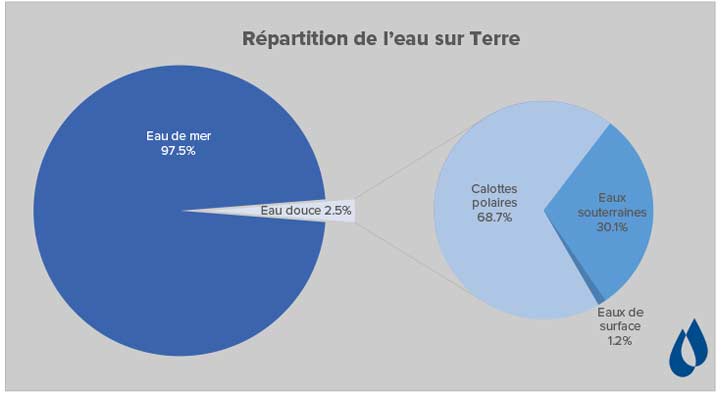
Source : https://www.waterlogic.fr/centre-de-ressources/pourquoi-economiser-l-eau/
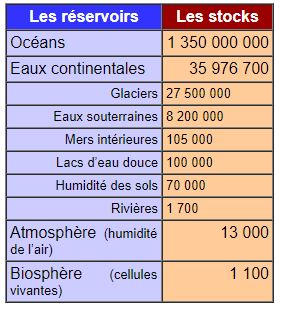
Source : http://sagascience.cnrs.fr/doseau/decouv/cycle/stocksEau.html
Who uses water ?
Did you know that we use 8 times more water than our grandparents?
Total water consumption on Earth is estimated at about 4 billion cubic meters per year, or 1.3 million liters per second!
This consumption can be divided into active consumption and passive consumption.
Active water consumption is water used for domestic purposes, agriculture, irrigation, and watering livestock, as well as industrial uses and all municipal or environmental uses.
Passive water consumption is water used for aquatic activities: pools, rivers, and water sports.
The CNRS estimates total direct domestic water consumption worldwide at an average of 40 liters of water per person per day.
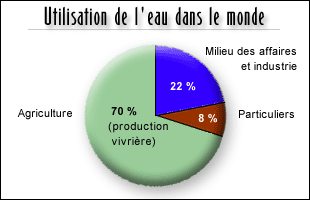
- 70 % for irrigation / agriculture
- 22 % for industrial activities
- 8 % for domestic use
Saving water every day
Small actions can still have an impact on water consumption when thousands of people take them. In our articles listed below, you will find plenty of ideas that are easy to put into practice at home and will significantly reduce your water consumption.
A closer look at household water consumption
7 tips to reduce your water consumption
7 additional tips to reduce your water consumption
7 more tips to reduce your water consumption in the garden !
This should also be accompanied by close monitoring of water networks. It is estimated that for every 5 liters of water withdrawn, nearly one liter is lost in urban areas before reaching your faucet, while nearly 2 liters disappear in rural areas! That amounts to an estimated 20 % water loss due solely to leaks in the networks!
Agriculture is often singled out, rightly so, especially intensive agriculture, which uses enormous amounts of water to increase yields. While crops obviously need watering to prevent them from scorching where they grow, appropriate irrigation methods can also be adopted. Many farmers now water at night, which prevents excessive water loss through evaporation. Evaporation continues to increase with global warming. It is estimated that rivers and streams will lose 20 to 30 % of their flow rate within 40 years...
Global warming affects the hydrological cycle, and its consequences are not yet fully understood, as they unfold over the long term. However, we know that drought is increasing in regions already short of water, growing in both intensity and duration. Other parts of the world are experiencing increased rainfall events, leading to flooding or health problems.
The entire ecosystem is changing, with increased snowmelt, evaporation, and runoff, affecting erosion, which will also contribute to changes in the environment. Scientists agree that water and climate change will be the major issue of the coming decades.
Dams have been built around the world to help regulate water consumption. This technique dates back to ancient times, and today enormous dams are being built. However, while retaining water helps regulate and therefore limit its consumption, it also has drawbacks. The water held back by the dam stagnates and changes the plant and animal environment of the river or stream concerned. And we should not forget that building the dam has already transformed the site upstream by flooding land and villages.
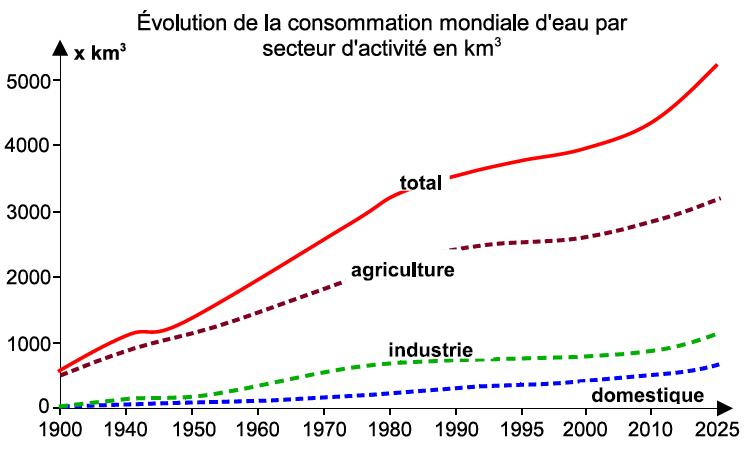
Water consumption worldwide
Source : http://www.activeau.fr/consommation-eau-monde.htm
A few ways to limit water overconsumption
- Water desalination : there are currently 3 plants in France. The main drawback is the price of the water, which is expensive to produce. These plants also cause pollution because they run on fossil fuels.
- Wastewater treatment : currently prohibited in France, this practice is used successfully in Australia and Singapore, although it remains costly.
- Water collection : at the individual level, water collection systems are easy to set up. At the local level, regions are starting to install retention basins, which serve, among other purposes, as water reserves for agriculture.
At Josmose.fr, we specialize in pure water and offer you many solutions for using good-quality water, whether with a home RO system or by using osmosis technology for professional applications. We advise you on water purification systems, reverse osmosis, and the differences between a water softener, ultrafiltration, and a water dynamizer. We are also deeply involved in water consumption in general, and offer you our advice and expertise in our blog posts about water, as well as by phone or email if needed.
Explore our full range of RO systems
To learn more, you can read the report : Overconsumption, a threat to water.
- Published on
- All About Water