Recherche dans le blog
News
We occasionally have news to share in this category.
Are France’s Rivers Polluted?
Water quality in France’s rivers
The water quality in French rivers is far from perfect, and we have already covered this topic in our article The Water Situation in France. However, pollution from organic matter and phosphorus compounds has decreased significantly, particularly thanks to the construction of wastewater treatment plants that capture organic matter as well as the nitrogen and phosphorus that used to accumulate on riverbeds.
What harmful substances are found in France’s waterways?
The organization Robin des bois stated in a report that more than 60,000 metric tons of hydrocarbons were discharged into French rivers each year. This figure seems enormous, yet it represents only a tiny fraction of the pollutants found in our rivers, because in addition to hydrocarbons, there are all kinds of pesticides, insecticides, and herbicides, as well as solvents…
Where does pollution in French rivers come from?
Intensive farming practices and pesticide use are often blamed, while we sometimes forget that pollution in our rivers also comes from industrial activities and household discharges. Amateur gardeners also contribute by using harmful products without realizing their negative impact on nature.
Although significant progress has been made since the 1970s, there is still considerable room for improvement before all French rivers are clean.
Did you know that road and garden maintenance is the second-largest source of pollution after agriculture? Urbanization comes next, with road development and the rapid spread of concrete.
Learning about water quality in waterways
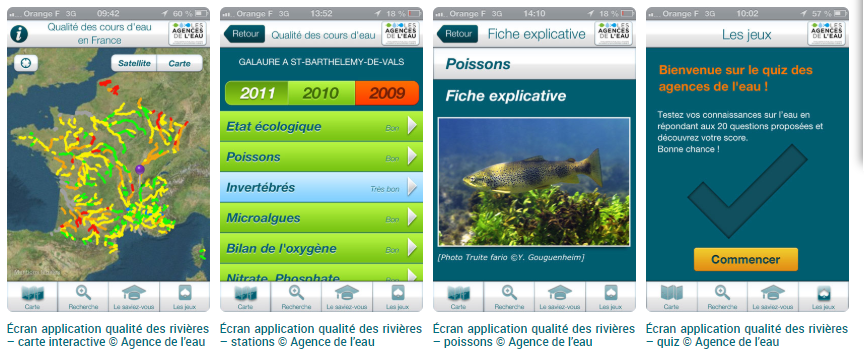
You can now easily learn about water quality in French rivers simply by using an app you can download to your smartphone. The “qualité rivière” app - an initiative of the water agencies and the Office national de l’eau et des milieux aquatiques (Onema) - lets you check the water quality of the river near your home or a waterway at your vacation destination. More than 5,000 waterway monitoring stations are listed and provide data on nitrate and phosphate levels, acidity, oxygen, temperature, microalgae, micropollutants...
With these parameters, you can tell at a glance whether the river where you want to take a dip or teach your children to kayak is healthy and safe for you. If you are curious, you can also discover the plants and animals in French rivers, as well as the protective measures taken to prevent waterway pollution.
However, it seems that the data provided by the app is not updated regularly, which is a real shame for effective monitoring!
 You can also review the data provided by the Ministère de l’Écologie to find out the level of exposure to various pollutants in your environment. More than 2,200 stations throughout France collect groundwater data, which is then analyzed and made available to everyone. Note that the latest figures displayed on the government website date back to … 2012
The map from Data Pesticides is very interesting to explore, although its data dates back to 2014. In 2013, the Ministère de l’Environnement stated in its Commissariat au Développement Durable report that “Pesticides are present in almost all French waterways. In 2013, 92 % of monitoring sites reported the presence of at least one of these substances, with the few pesticide-free river basins concentrated in mountainous areas or areas with less intensive agriculture.” You should know that pollution tests cover more than 670 different pesticides, making the data fairly complex to work with, since more than 400 active substances have been recorded in French waters!
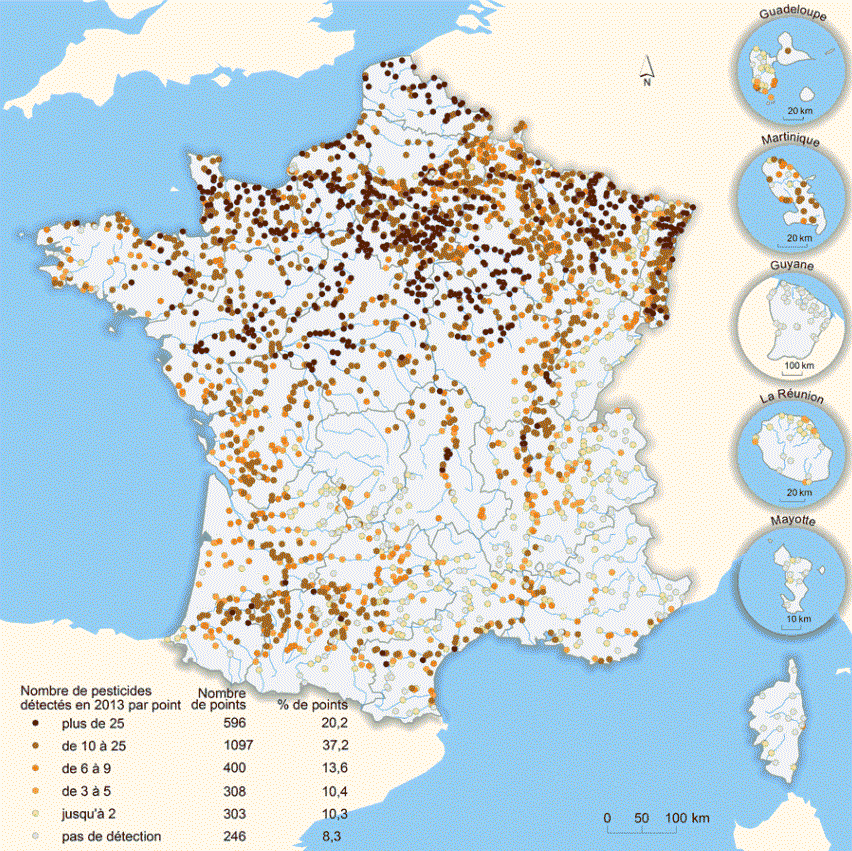
Number of different pesticides detected in 2013 at each waterway monitoring site
Sources: water agencies and offices. Data processing: SOeS, 2015
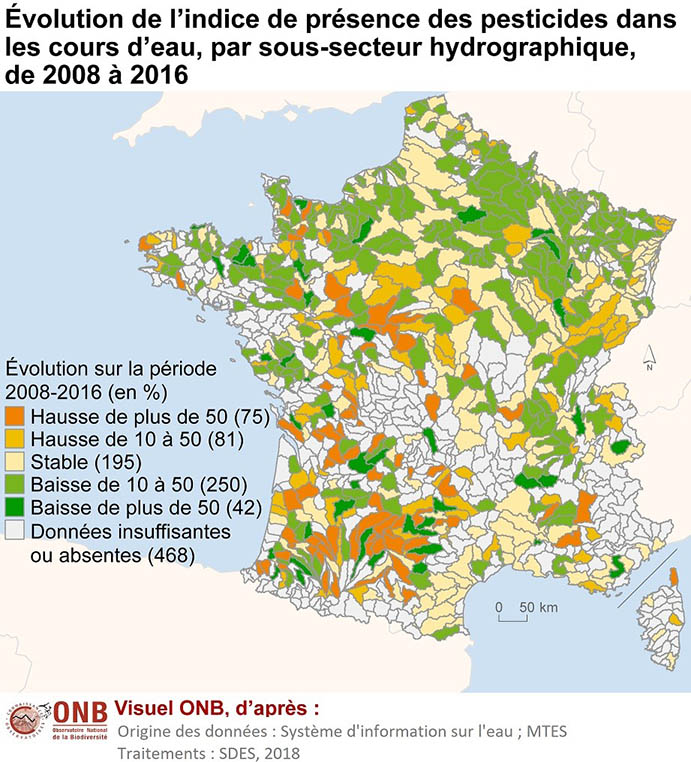
On the Observatoire National de la Biodiversité website, you will also find many very interesting maps compiling data through 2016.
The 15 most frequently detected pesticides in French river water
The 15 most frequently detected pesticides in 2013 were almost exclusively herbicides, with glyphosate at the top of the list.
- AMPA, the main breakdown product of glyphosate
- Glyphosate, the best-selling herbicide in France for agricultural and nonagricultural uses.
- Desethylatrazine, a breakdown product of atrazine
- 2-hydroxyatrazine, a herbicide banned for 10 years
- Metolachlor (herbicide)
- S-Metolachlor (herbicide)
- DEDIA (herbicide)
- Boscalid (fungicide)
- Chlortoluron (herbicide)
- Isoproturon (herbicide)
- Atrazine (herbicide)
- Bentazone (herbicide)
- Metazachlor (herbicide)
- Diuron (herbicide)
- Imidacloprid, an insecticide belonging to the controversial neonicotinoid family, (neurotoxic insecticides characterized by high toxicity to insects, a broad spectrum of action, and long persistence in different parts of the environment (air, water, soil). This pesticide is increasingly detected in waterways and has appeared in the top 15 since 2013.
Source : https://www.notre-planete.info/actualites/4383-pesticides-cours-eau-France
Good practices for improving water quality in French rivers
The benefit of caring for our rivers is immediately visible : as soon as a waterway becomes less polluted, the river is oxygenated again, and plants and animals quickly return.
France has committed to Europe to have 100 % of its rivers in good ecological condition by 2027. Although this goal still seems difficult to reach, we can welcome the growing awareness among government agencies and the public, along with the significant efforts already made. However, we should not declare victory too soon, because global warming, once again, tends to lower river levels, increasing pollutant concentrations relative to the amount of water present, while high temperatures cause the entire aquatic system to deteriorate.
What can you do every day? You can start by making a habit of eating organic food : fruits and vegetables grown without pesticides or products that pollute or harm the environment and, of course, your health. Then adopt good habits by removing many polluting products from your daily routine and returning to simple products : cleaning with white vinegar, homemade laundry detergent, and homemade shampoo and soap made with natural ingredients… and of course, you can avoid spraying your garden with all kinds of herbicides or fungicides! Why not try permaculture?
Only through widespread awareness among authorities, industries, and the public can we work together to adopt good habits for our planet and preserve our water quality.
You can also test the quality of your tap water (because, of course, river water pollution affects tap water, even after it has been filtered and treated at a wastewater treatment plant!) with our water test kits. And if you want to drink pure water that is good for your health, it is time to take the next step and equip your home with a home RO system !
- Published on
- News,
- All About Water for Everyone
Related products