

Recherche dans le blog
REVERSE OSMOSIS
What Is a Reverse Osmosis System?
Vincent's Bioelectronics and Reverse Osmosis
Why Install a Reverse Osmosis System?
The Health Benefits of a Reverse Osmosis System
- A high-quality drink
- Water that is easy to drink
- More reasons
- Your kidneys will thank you
- More advantages of RO systems
Reverse Osmosis System: Pros and Cons
How to Choose a Home Reverse Osmosis System
- RO water definition
- RO water and health
- RO water and aquariums
- RO water and pH
- RO water and demineralized water
- RO water or spring water?
- How to make RO water
- "A RO system is expensive" - Not anymore!
- How much does RO water cost?
Frequently Asked Questions About RO Systems
- Why are prices so low?
- RO system installation
- Where?
- How much space?
- How long does it take?
- What tools?
- How do you drill a sink?
- How do you connect the water?
- How much does the whole system weigh?
- Home uses
- Baby bottles?
- Ice cubes?
- American-style fridge?
- Face and hair?
- Plants?
- Windshield washers?
- Heating appliances?
- Dishes?
- Windows?
- Maintenance
- Technology
- Advantage of the booster pump?
- Disadvantage of the booster pump?
- Benefit of quick connectors?
- Benefit of a UV sterilizer?
- Benefit of a TDS tester?
- What TDS level can you expect?
- Performance
How to Install a Reverse Osmosis System
Technical Explanations on Using RO Systems
- Why Does TDS Rise in the First Centiliters of Water Produced?
- Why Does TDS Rise When the RO System Is Idle?
- Why Does My Tank-Based RO System Sometimes Start and Sometimes Not?
- My RO System Produces Less Water: Why?
- How to Avoid Drilling Your Countertop
Reverse Osmosis System Maintenance
- What are Total Dissolved Solids (TDS)?
- Where do dissolved solids come from?
- Why measure the TDS level of your water?
A Reverse Osmosis System With No Wastewater?
- Why does a RO system produce wastewater?
- How to limit wastewater
- Wastewater-free technology: ultrafiltration
Looking for a Reverse Osmosis System Manufacturer?
Why Is the Reverse Osmosis System the Ideal Product in Africa?
Tip: Manage Your UV Lamp Automatically
For years, we have regularly received feedback from customers about managing the UV lamp we offer as an option on our RO systems. This UV lamp can be very useful on a tank-based RO system because, as water stagnates in the tank, a bacterial biofilm can develop. The problem our customers encounter is this : when the RO system is idle, the water inside the stainless steel protective tube heats up and becomes unpleasant to drink. Until now, we offered them a partial solution : plugging the UV sterilizer into a switched outlet so they could turn it on and off every time they used RO water. In addition to being slightly cumbersome, this solution required our customers to remember to turn the lamp on and off each time. If they forgot to turn it on, the water was not sterilized, and if they forgot to turn it off, the water was hot the next time. One of our very resourceful customers, Charles Piette, found THE ideal solution. Read his testimonial below.
“ If you install a manual switch, you either forget to turn it on or forget to turn it off.
So how can you activate the UV lamp as soon as you draw water and cut off its power after a certain time, allowing it to sterilize the water in the stainless steel tube where the lamp is located for the next use?
To do this, we need a flow controller and a timer that will switch off after a certain time.
I bought the following components :
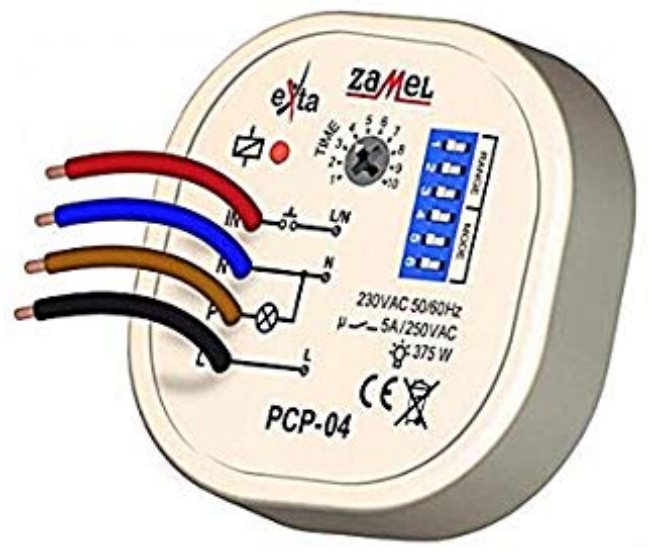
‐ Zamel PCP‐04 multifunction time-delay relay for flush-mounted boxes for about 15 €
‐ G1/2" brass Hall-effect water/liquid flow sensor switch DC250V 70W1‐30L/min for about 10 €

- 80x80mm junction box- Straight fittings, ½ threaded female / ¼ female
I attached this sensor (1) as shown in the photo, using plastic cable ties (2) on the side of a junction box measuring 8 cm on each side, passing the two wires through the flexible cable gland. I had attached the two fittings (3) to it beforehand.
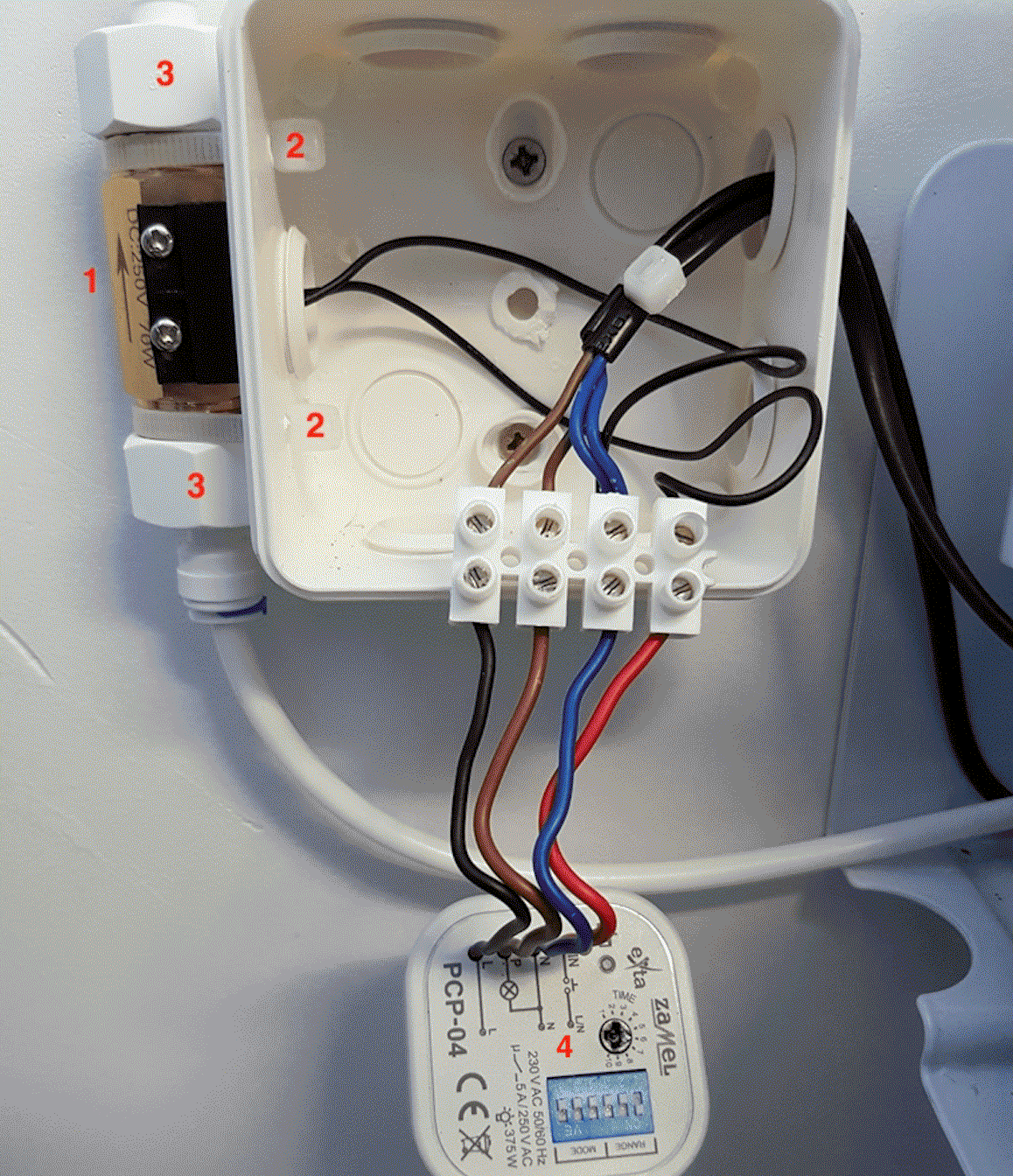
At the bottom of the photo, you can also see the PCP‐04 timer relay (4), which is wired according to the diagram to :
- The incoming power supply at N and L. Since the power cable for my UV lamp’s transformer was long enough, I cut it in half.
- The output to the lamp at N and P.
- The flow controller at N and IN. When you order this device on Amazon, you receive complete instructions “in English” for setting the functions and timing.
The following photo shows how the 1/4-inch tubing is connected :
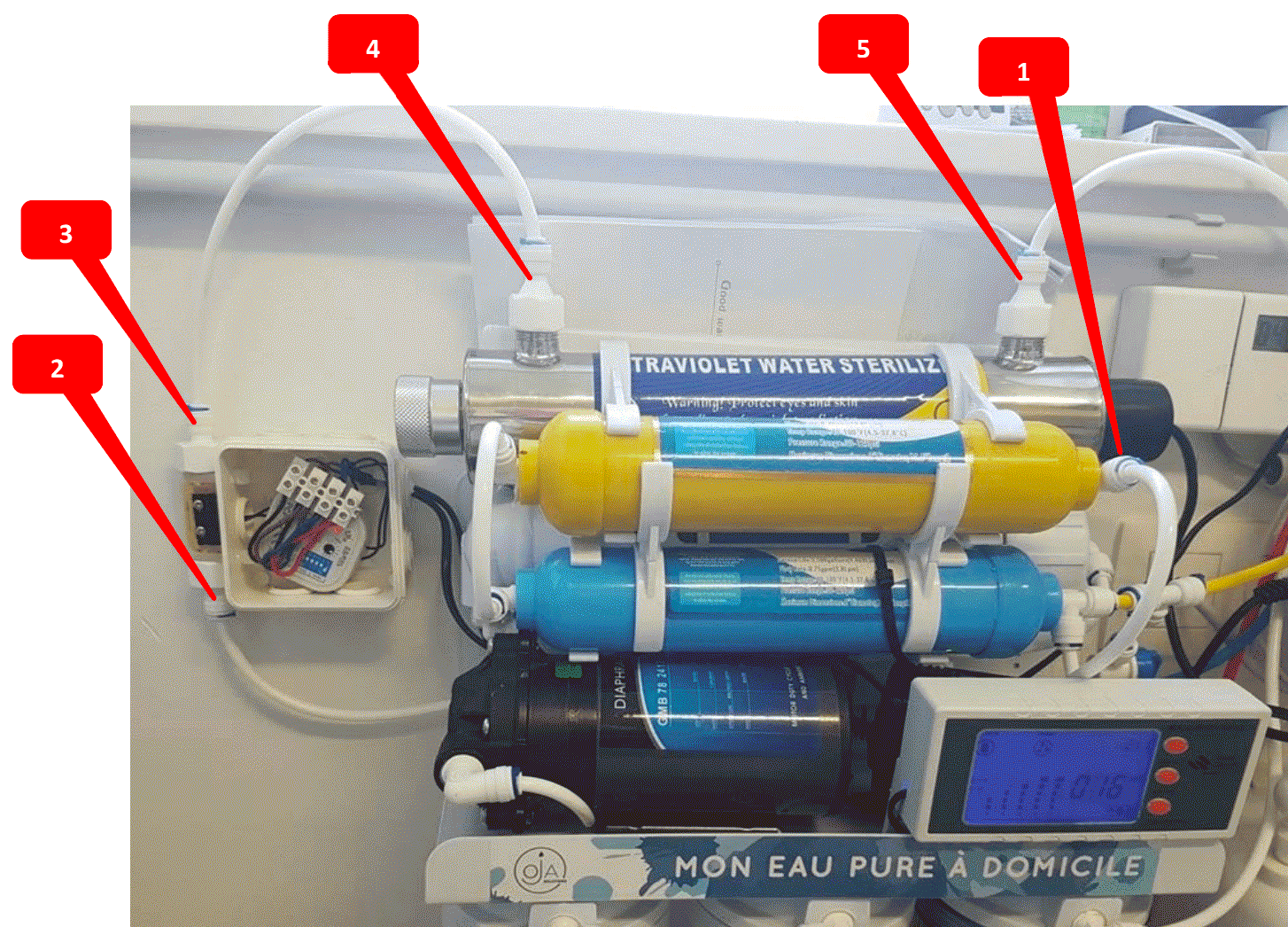
‐ 1 : outlet from the “carbon filter” cartridge to 2
‐ 2 : inlet to the flow sensor
‐ 3 : outlet from the flow sensor to 4, UV lamp inlet
‐ 4 : UV lamp inlet
‐ 5 : UV lamp outlet to the dispensing faucet
There you have it. I set the timer to 5 minutes, knowing that the UV exposure time needed while pumping the water is much shorter. Even if this time varies by a factor of three, any bacteria will indeed be destroyed by the UV light.
Here is the completed installation.
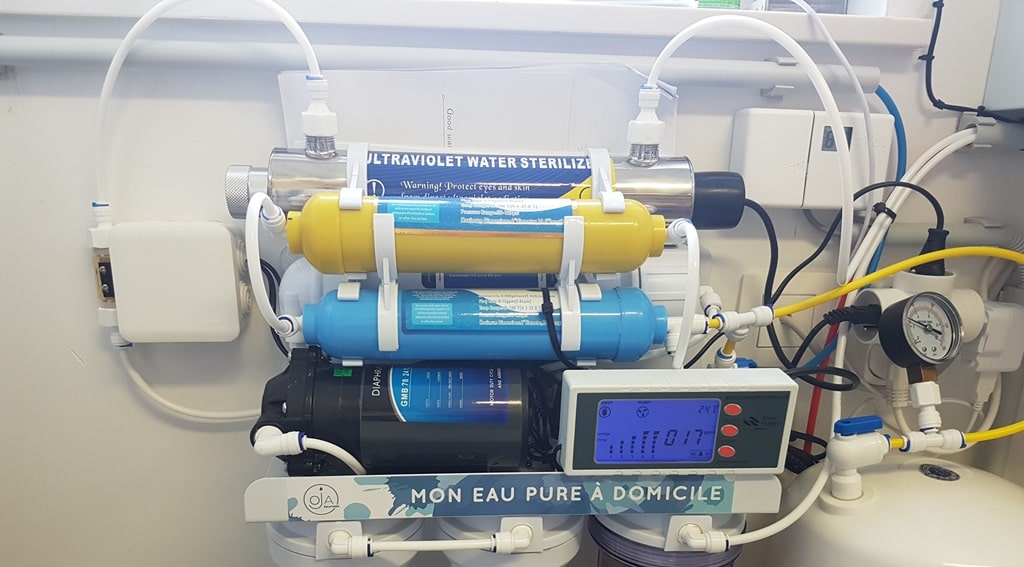
PS : There is a discrepancy between the voltage ratings on the flow controller, which indicates DC 250V 70W, and the relay, which indicates 230V AC, but this does not cause any operating problems. It has been installed here for more than a week, and it works correctly. ”
Charles Piette.
- Published on
- REVERSE OSMOSIS,
- A Splash of Articles,
- FILTERING YOUR DRINKING WATER
Related products