


Recherche dans le blog
Scientific Articles
- A few figures?
- Why drink water?
- When should you drink water?
- How much water should you drink each day?
- Signs of dehydration
- Qualities required for good drinking water
Why Should You Avoid Drinking Softened Water?
- The reason given by the WHO
- Further details on water softeners
- Maintenance considerations
- An alternative to conventional salt-based water softeners
Should You Filter Tap Water in France?
- The official answer: No, water filtration is not necessary
- According to scientists: Yes, purifying your drinking water is essential
Can Your Body Absorb the Minerals in Drinking Water?
- An interesting study in Germany
- What does the WHO think?
- Water for dummies
- The study results
- The minerals in water are not bioavailable
- Other drawbacks of mineral water
A Closer Look at Dry Residue in Water
- Drinking water: a luxury in France?!?
- Pesticides and other little gifts in tap water
- As with VW, the levels change, but the nature stays the same...
- Another major problem: water chlorination!
- Are we drinking medicated water?!?
- What goes unnoticed in health safety tests...
- ...but not under scientists' scrutiny, as they even find heroin in tap water
- Laboratories' conflict of interest
Drinking Water Around the World
Beware of Natural Water Sources!
- Double standards…
- Bottled waters have very different mineral levels
- A few unexplained peculiarities
- The case of Cristaline water
- Thermal waters
- Beware of minerals!
- And where does soda fit into all this?
How to Read Your Mineral Water Label
- Dry residue
- Anions/cations
- Calcium
- Magnesium
- Sodium
- Potassium
- Bicarbonate
- Chloride
- Sulfate
- Nitrate
- The bioavailability of minerals in water
Municipal Water and Nanoscale Particles
Aluminum in Water Doubles the Risk of Developing Alzheimer's Disease
- A danger worse than asbestos
- Tap water, a cocktail of chemical medications
- What the « official recommendations » don't say
Water Treatment With UV Radiation
Introduction
Since the early 20th century , UV radiation has been known to eliminate many forms of life, including bacteria, yeasts, viruses, amoebas, and certain parasites... At the time, however, methods for harnessing the sterilizing power of UV were too expensive for widespread use. A few decades later, a physicist named Ashok Gadgil revisited the treatment of contaminated water using UV irradiation. His work was driven by a desire to develop a low-cost water sterilization process to meet the needs of the poorest countries. The 1993 cholera epidemic known as the “Bengal” epidemic, which devastated northern India, sparked this interest.
Professor Gadgil's goals were as follows :
- Low cost : an investment of less than 2 dollars per user per year (for a village of 2,000 residents).
- Easy maintenance : the lamp needed to be suspended above the water rather than submerged, without losing radiation, to limit electricity consumption.
- A sufficiently high flow rate to supply a village, reaching 15 liters of treated water per minute.
The first “UVW” technology, short for “UltraViolet Waterworks,” was developed in 1996.
This scientific achievement and his noble intentions earned him numerous awards, including the Health Award in 2004, as well as inclusion at Chicago's Museum of Science and Industry among artists and scientists embodying “the spirit and creativity of Leonardo da Vinci.”

Ashok Gadgil, European Inventor Award, May 19, 2011
An overview of ultraviolet rays
Ultraviolet radiation, or UV, is invisible to the human eye. On the electromagnetic spectrum, its wavelengths range from 10 to 400 nanometers (with 10nm marking the boundary with X-rays and 400 nm the boundary with the spectrum visible to the naked eye).
Ultraviolet rays have different applications depending on their wavelength :
- “UV-A” is used to stimulate skin pigmentation (melanin production). On the electromagnetic spectrum, UV-A rays range from 315 to 400 nm.
- “UV-B,” with wavelengths ranging from 285 to 315 nm, is mainly used in processes that enrich food with vitamins.
- Ranging from 200 to 280 nm , “UV-C” has germicidal activity (against bacteria, viruses, protozoa, etc.). Peak germicidal activity occurs between 254 and 260 nm.
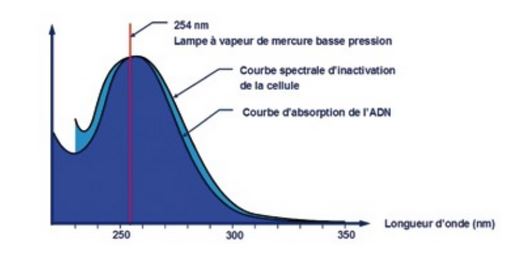
Microorganism inactivation curve for UV treatment
This activity is now widely used in sterilization processes, in the pharmaceutical industry, food processing, and water treatment. UV water disinfection is already widespread in Germany and Austria, while it has struggled to gain a foothold in France.
How UV-C works
UV-C affects the genetic material of the various microorganisms found in water. The fluence is absorbed by their DNA and RNA (so even RNA viruses are directly affected). The absorption spectrum of nucleotides ranges from 210 to 310 nm, with an absorption peak around 260 nm. This applies to purine bases (adenine and guanine) and pyrimidine bases (uracil, thymine, and cytosine).
Depending on UV-C exposure, the genetic code of the targeted organism undergoes various forms of distortion. The photoproducts are most often pyrimidine dimers. This modification of the genetic code deprives the targeted organism of its ability to reproduce and may even kill it directly. The most common photoproducts are thymine dimers (T-T). Uracil dimerization is harder to trigger, which explains why RNA viruses are more resistant.
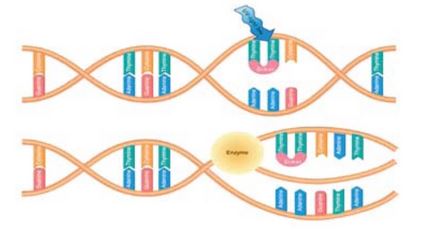
One advantage of treating water in a reactor with a UV lamp is that UV does not alter the water's physicochemical matrix, whereas chemical disinfectants (ozone, chlorine, bleach, chlorine dioxide) generate byproducts that can sometimes be toxic. Water quality therefore remains the same as before treatment, but without the unwanted organisms. The process is thus environmentally friendly and economical.
The equipment needed to make water safe to drink
The first component is the UV lamp, which comes in different types depending on the application. Several conditions must be met to make water safe to drink. First, the water must be clear. Studies have shown that iron, phenolic compounds, sulfonates, humic acids, and dyes interfere with UV radiation, reducing its effectiveness.
The water must be as free of suspended matter as possible, since organisms can easily shelter in its shadow and survive. Suspended matter and dry residue, meaning all total dissolved solids (TDS), directly affect turbidity (a measure of light scattered by a particle exposed to radiation), so it is essential to purify the water beforehand.
The second component is the ballast (the lamp's transformer). It must supply the lamp with the voltage needed to produce a sufficient dose of UV rays.
For example : To make purified water safe to drink, the lamp must deliver 100 mWs/cm² (this unit measures the “radiation dose” and can also be expressed in J/m²) in contact with the targeted elements for 10 to 20 seconds.
To maintain sterilization, the elements farthest from the radiation source must be exposed to a minimum radiation dose of 15mWs/cm².
The Beer-Lambert law is used to calculate this “UV dose” or “fluence” :
D (exposure dose) = P / S × exp(-KY)×T where “P” is the lamp's power in Watts, “S” the emitting surface area in m², “K” the absorption coefficient of the liquid being treated in m-1, “Y” the thickness of the water layer in m, and “T” the exposure time in s.
The final component is the reactor. There are two types: closed and open. Only closed reactors are used to eliminate microorganisms. Their purpose is to maximize the effects of UV energy to provide disinfection at a lower cost.
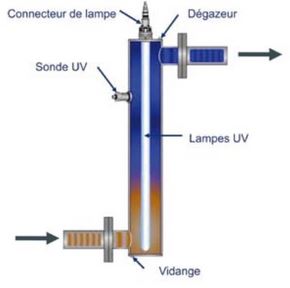
Diagram of an industrial UV lamp
In practice :
As explained earlier in this article, UV lamps are only truly useful when used on water from which as many suspended particles as possible have been removed, allowing the radiation to reach all microorganisms. They are therefore installed downstream of filtration systems that have already removed the largest suspended solid particles.
To remove these particles, ultrafiltration systems (for suspended particles only) or reverse osmosis (RO) systems (also for dissolved particles) are recommended for initial water treatment.
Microorganisms that have passed through the membranes and/or developed downstream of them will be destroyed by the UV lamp. In practice, UV lamps are therefore used downstream of an ultrafiltration system or a tank containing water that has already been filtered by ultrafiltration and/or reverse osmosis. Oja Solutions offers UV lamp disinfection solutions tailored to the needs of individuals, professionals, and industrial users.
Lamp power is tailored to your needs based on your desired flow rate. https://www.josmose.fr/osmoseur/accessoires-osmoseur/lampe-uv/lampe-uv-phillips-2-clips
This article offers installation tips to limit the electricity consumption of UV lamps : https://www.josmose.fr/en/blog/123-manage-your-uv-lamp-automatically
Dr. Clément Parmentier
Sources :
- https://www.wipo.int/ipadvantage/fr/details.jsp?id=2564
- https://www.emse.fr/~brodhag/TRAITEME/fich19_1.htm
- https://www.u-picardie.fr/beauchamp/duee/mignot.htm
- Published on
- Scientific Articles