


Recherche dans le blog
Scientific Articles
- A few figures?
- Why drink water?
- When should you drink water?
- How much water should you drink each day?
- Signs of dehydration
- Qualities required for good drinking water
Why Should You Avoid Drinking Softened Water?
- The reason given by the WHO
- Further details on water softeners
- Maintenance considerations
- An alternative to conventional salt-based water softeners
Should You Filter Tap Water in France?
- The official answer: No, water filtration is not necessary
- According to scientists: Yes, purifying your drinking water is essential
Can Your Body Absorb the Minerals in Drinking Water?
- An interesting study in Germany
- What does the WHO think?
- Water for dummies
- The study results
- The minerals in water are not bioavailable
- Other drawbacks of mineral water
A Closer Look at Dry Residue in Water
- Drinking water: a luxury in France?!?
- Pesticides and other little gifts in tap water
- As with VW, the levels change, but the nature stays the same...
- Another major problem: water chlorination!
- Are we drinking medicated water?!?
- What goes unnoticed in health safety tests...
- ...but not under scientists' scrutiny, as they even find heroin in tap water
- Laboratories' conflict of interest
Drinking Water Around the World
Beware of Natural Water Sources!
- Double standards…
- Bottled waters have very different mineral levels
- A few unexplained peculiarities
- The case of Cristaline water
- Thermal waters
- Beware of minerals!
- And where does soda fit into all this?
How to Read Your Mineral Water Label
- Dry residue
- Anions/cations
- Calcium
- Magnesium
- Sodium
- Potassium
- Bicarbonate
- Chloride
- Sulfate
- Nitrate
- The bioavailability of minerals in water
Municipal Water and Nanoscale Particles
Aluminum in Water Doubles the Risk of Developing Alzheimer's Disease
- A danger worse than asbestos
- Tap water, a cocktail of chemical medications
- What the « official recommendations » don't say
How to Read Your Mineral Water Label
What does mineral water contain ? What information matters when choosing your drinking water ? Is water that contains nitrates good water or, on the contrary, bad water ? In this article, we examine the role of the minerals present in water.
Dry residue level : an overall measurement
As Professor Marc Henry explains in his lecture : Which Water Should You Drink ?, dry residue is a key measurement when choosing drinking water.
This dry residue level is expressed in mg/l. Some measuring tools provide readings in PPM, which is the English-language equivalent of mg/l.
Professor Marc Henry is very clear about the quality of the water you should drink : “good water” is water with a dry residue below 100 mg/l.
Check your water bottles: this information is mandatory and must appear on the label.
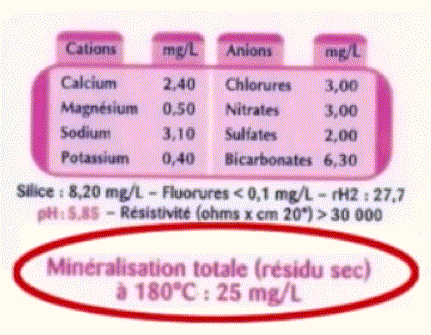
You can see that this level is broken down by mineral, with cations on the left and anions on the right. We will first define anions and cations before identifying the role of each mineral individually.
Anions/Cations : an introductory definition for analyzing minerals in water
Cations and anions are ionic elements. This means they are chemical elements carrying electrical charges :
- A cation is a chemical element carrying a positive electrical charge
- An anion is a chemical element carrying a negative electrical charge
The minerals present in water are dissolved, invisible to the naked eye, and present in ionic form.
The experiment known as electrolysis makes these ions visible. This experiment uses a device called an electrolyzer, which sends electrical pulses that cause the elements contained in the water to react.
Watch our electrolysis experiment on video : simply compare our glasses of different waters at the end of the experiment to easily understand that it is urgent to become aware of the quality of the water we drink !
The role of calcium CA2+ in the body
“Drink milk, it contains calcium, and it is good for your bones”. This encouragement parents give their children is well-intentioned and true. Calcium plays a role in growth and skeletal maintenance, but that is not all. It is also important for the nervous system and blood clotting.
A healthy adult needs 900 mg of calcium per day. A lack of calcium in the blood (blood calcium levels) leads to depletion of bone tissue. It is therefore important to consume dairy products and vegetables.
Getting calcium from drinking water is not very effective, however. Adding 50 g of Gruyère to your pasta is equivalent to drinking more than 6 bottles of water of 1.5 L each ! Impossible unless you spend the day in the bathroom
- 50 g of Gruyère → 500 mg of calcium
- A bottle of Evian contains 80 mg of calcium
- It therefore takes more than 6 bottles of water to provide as much calcium as a bite of cheese !
The role of magnesium Mg2+ in the body
Magnesium helps transmit information from the brain to the muscles. It is often considered a natural relaxant.
Unlike calcium, the body has no magnesium reserves. Daily needs vary with age, and sweating contributes to magnesium loss. Finally, pregnant women, older adults, and athletes need to pay particular attention to their dietary magnesium intake.
A child's needs range from 80 mg per day at ages 1 to 3 to 340 mg at age 16.
An adult needs approximately 400 mg per day.
A lack of magnesium causes persistent fatigue, tension, stress… The body needs this mineral for information from the brain to reach the muscles properly; without magnesium, our brain works harder, and we therefore feel intense fatigue…
A well-known water on the market promotes its benefits for bowel movements and constipation, backed by a scientific study.
The magnesium content of the water with the highest concentration : H...R is 119 mg/L. You would therefore need to drink three liters of this water to cover your daily needs, and more if you want a laxative effect ! Could the placebo effect actually be just as strong as the laxative effect ?
To give your body the magnesium it needs, you can also eat nuts such as almonds or hazelnuts, as well as green vegetables, whole grains, or legumes… ingredients that are easy to incorporate into your diet ! Our team has a slight preference for cocoa : the perfect excuse to indulge in chocolate !
The role of sodium Na+ in the body
Sodium helps regulate water in the body. Combined with other salts, such as bicarbonate, it contributes to the blood's acid-base balance.
Requirements are high : 5 to 10 g per day. It is clear that drinking water cannot help you reach your sodium intake : you would need to drink between 6 and 8 bottles of water per day !
It is therefore through food, mainly sodium chloride - table salt, that we provide our bodies with the necessary amount of sodium. But as with everything, moderation is key ! With today's diet, sodium deficiency is extremely rare; on the contrary, our diet is often far too salty, and we face conditions caused in part by excessive sodium consumption : high blood pressure, heart failure, stroke, myocardial infarction, kidney failure…
The only benefit of drinking water with a high sodium concentration is therefore to speed up rehydration during illness. Otherwise, the best advice we can give you is to limit your consumption of table salt, which has real and significant effects on the body.
The role of potassium K+ in the body
Potassium is a nerve catalyst: its role is to improve nerve impulses and thereby promote contraction of the muscles and heart. Potassium helps eliminate and prevent muscle cramps.
Daily requirements are high for adults : 3 to 5 g per day,
They are much lower for children : 0.5 to 1 g per day.
Potassium is found in dried fruit, bananas, vegetables, and grains. It is also found in certain teas. Meeting your daily potassium intake through drinking water is inconceivable, so the necessary amounts are consumed through food.
A potassium deficiency has the same effects as a magnesium deficiency : a feeling of fatigue and muscle weakness. Doctors often prescribe courses of magnesium and potassium together. A potassium overdose is rare because it is eliminated in urine.
The role of bicarbonate HCO3 in the body
Athletes know that drinking sparkling water after exercise helps you recover better and faster. Why ? Because of bicarbonates ! Here are a few explanations.
- Exercise causes sweating, which makes the body acidic
- Bicarbonate reduces acidity in the body
- Bicarbonate is produced by dissolving carbon dioxide in water, which produces sparkling water
The bicarbonate contained in water therefore helps rebalance stomach acidity and stabilize blood pH, helping the body recover more quickly. Since bicarbonate is the source of sparkling water, athletes are therefore right to drink sparkling water after exercise to recover more quickly.
Bicarbonate is found in fruits and vegetables, as well as in water.
The role of chloride Cl- in the body
Chloride, derived from chlorine, is a mineral you should be cautious about. Although useful for the body's balance, it is already supplied naturally by sodium chloride (table salt) in your diet.
The daily chloride requirement is 1 g per day.
Seawater contains a lot of sodium chloride, or salt, and everyone knows it is undrinkable…
Chlorine can be tasted at a concentration of 200 mg/L. This is therefore a limit that should never be exceeded in drinking water ! Chlorine and chlorides are also widely used by industry to prevent bacterial growth in tap water. Although effective, this technique is not environmentally friendly and gives tap water an unpleasant taste.
We therefore naturally recommend drinking water with a very low chloride content.
The role of sulfate SO42- in the body
A major source of sulfur, sulfates are found in our nails and hair, in our insulin, and in our tendons and bones.
An adult's sulfate requirement is 13-14 mg per kilogram.
Another characteristic of sulfates : they are excellent for speeding up intestinal transit, but be careful: excessive consumption can cause diarrhea !
Seafood, legumes, meat, milk, and eggs contain sulfur, as do certain mineral waters. As a result, vegetarian or vegan diets often cause sulfur deficiencies.
The role of nitrate NO3 in the body
Nitrate is used as a food preservative, in addition to its use in fertilizers.
A balanced diet rich in fruits and vegetables supplies the nitrates the body needs : approximately 300 to 500 mg of nitrates per day.
Sources of ingested nitrates :
- 7 % from meat
- 13 % from water
- 30 % from fruits and vegetables
But our body also produces the nitric oxide it needs.
The bioavailability of minerals in drinking water
The bioavailability of minerals remains an open scientific debate, which we discuss in our article : Can the Minerals in Drinking Water Be Absorbed ?
The debate remains unresolved between those who claim that minerals in water are not absorbed at all, or only minimally, by the human body unless we consume plants or animal-based foods that have already assimilated these minerals. And those who believe that all living beings (humans, animals, and plants) have the means to capture these minerals and then assimilate them.
This article simply shows that we should move beyond the debate about the bioavailability of minerals in drinking water, because significant mineral intake comes from food, not water. As Professor Marc Henry regularly points out, the purpose of water is to cleanse the body.
- Published on
- Scientific Articles,
- Test Your Water or Have It Tested