There are cyanides in some foods and in drinking water, particularly in developing countries, but at very low concentrations. Polluting industries, especially mining and gold mining in particular, are the main cause of high cyanide concentrations in drinking water sourced from surface water.
Standards for cyanide in water**
Cyanide is generally present in drinking water at concentrations well below those likely to cause toxic effects.
ISO 14403-1:2012 specifies methods for determining cyanides in various types of water at concentrations ranging from 2 µg/l to 500 µg/l, expressed as cyanide ions in the undiluted sample.
ISO 14403-1:2012 describes a suitable mass concentration range from 20 µg/l to 200 µg/l.
Effects of cyanide on the body
Mild cyanide poisoning can cause dizziness or a feeling of intoxication, confusion, or mild breathing difficulties.
Severe poisoning causes breathing problems and asphyxiation that can lead to death.
A powerful poison, cyanide can also cause sudden death within minutes through a coma with convulsions. Literature is full of successful murders using this poison and no one has forgotten the cyanide pills that soldiers or spies concealed on their person and swallowed if captured by the enemy.
**A guideline value is a reference value provided by the WHO.
How do you test for cyanide in your water with the Micro20 photometer?
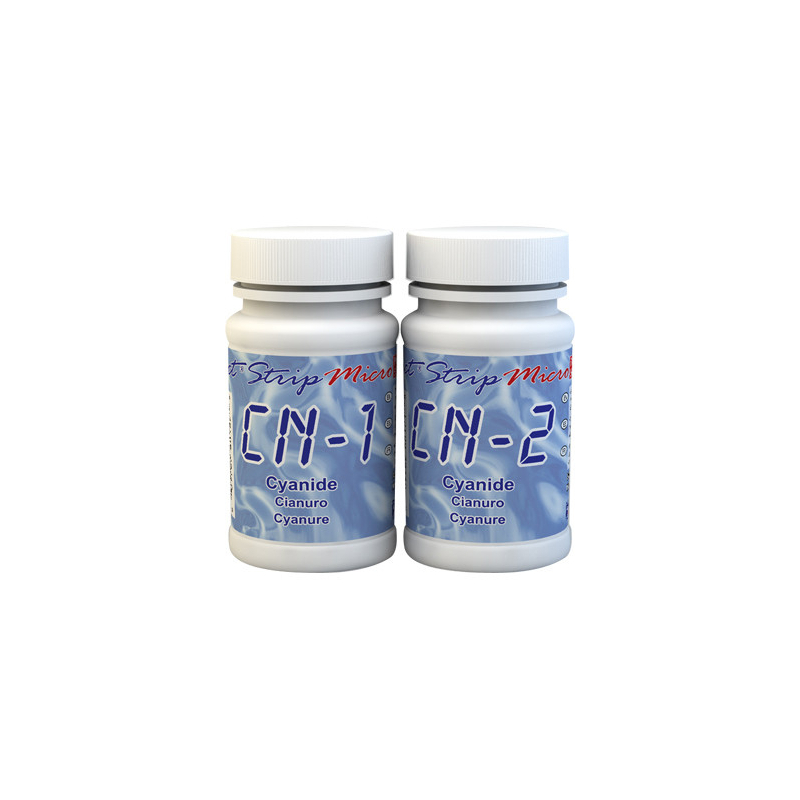
PREPARE THE TEST - Prepare one strip from each bottle (CN-1 and CN-2) for this test. Close the bottles immediately.
TURN ON THE DEVICE - Turn on the photometer by pressing the ON/ZERO button. The screen will show all indicators, then the selected menu, then the most recent results.
SELECT THE GROUP AND PARAMETERS - Press the SELECT button repeatedly to choose the group : the cyanide test is in group 7. Then press the MENU button repeatedly to select the test parameter : CN. (You will find all this information in a table in the user manual supplied with the device).
RINSE AND FILL THE SAMPLE CELL - Rinse the sample cell at least 3 times with the water you are going to test (to reduce the risk of cross-contamination from your previous test). Fill the small cell completely with the water to be tested.
ZERO - Press the ON/ZERO button. The cursor will move across the screen, which will then display 0.00 PPM. This indicates that the sample is ready to be tested.
DIP THE STRIP AND PRESS READ - Dip the CN–1 strip into the CELL, then immediately press READ. This starts the 30-second countdown. Since the strip is 8 mm wide, you will need to tilt it to fit it into the cell. Make sure the test pad is completely submerged. During this time, gently move the strip back and forth (about 2 movements per second). Remove and discard the strip after the ‘1’ disappears from the screen. The cursor will move across the screen, and at that point, get ready to dip the CN–2 strip into the CELL.When the 30-second countdown begins, immediately dip the CN–2 strip into the CELL. During this time, with the strip slightly tilted, gently move it back and forth (about 2 movements per second). Remove and discard the strip after the ‘1’ disappears from the screen. The meter will automatically start counting up to 600 seconds. At 600 seconds, the cursor will move across the screen while the meter prepares the sample reading. Record the displayed result. This result is automatically stored in the CN menu, and if you use the eXact iDIp® app, it will also be stored in the app's 'RESULTS'. After the test, immediately rinse the CELL and clean it with the brush.
NOTE : The meter's calibration is based on a water temperature between 20°C (68°F) and 25°C (77°F). If the temperature is below 20°C (68°F), the final cyanide reading may be low.
https://www.josmose.fr/en/water-analysis/water-tester/cyanide-water-diy-test620Cyanide in Water - Do-It-Yourself Test<p><span lang="fr">This kit of 50 test strips lets you check for <strong>cyanide</strong> in your water. </span></p>
<p><b><span lang="fr">Caution</span></b><span lang="fr">, this test kit only works with a <strong><a href="/en/water-analysis/water-tester/exact-micro-20-photometer" target="_blank">Micro20 photometer</a></strong>.<span style="text-decoration: underline;"></span></span></p>
<p>Pour the water to be analyzed into your photometer, dip the strip, and simply read the result!</p>https://www.josmose.fr/3285-home_default/cyanide-water-diy-test.jpg39.99instock39.9933.325002024-07-10T15:58:34+0200/Water Testers/Water Testers/Micro20 Photometer Tests