



Tested and inspected RO systems for pure water at a reduced price.
See offers
Complete protection with an RO system and a water softener.
Get 15% off
Combine reverse osmosis water and hydrogen-rich water.
Get 15% offFREE SHIPPING
On orders of €150 or more within mainland France
(home products only)
Ships within 24 hours
+33 3 66 88 17 85
Call us Monday to Friday,
9:30 am–5 pm (Paris time)!
Email: contact@josmose.fr

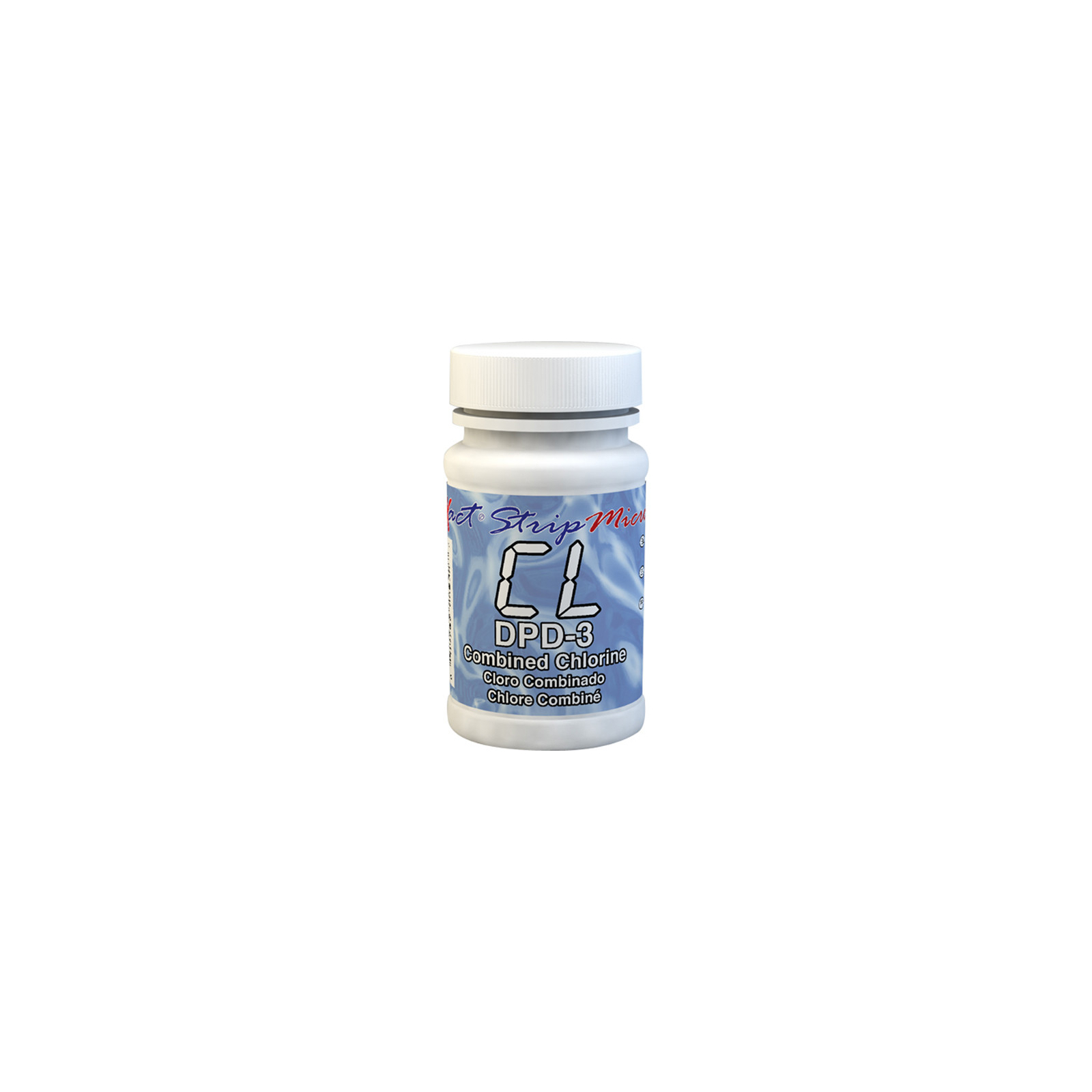
For pools and spas, you can test 3 types of chlorine, each with its own purpose :
In summary, testing total chlorine lets you monitor overall water disinfection, testing free chlorine ensures effective disinfection, while testing combined chlorine helps detect potential problems with overchlorination or underchlorination.
Combined chlorine, also known as combined residual chlorine, forms when chlorine reacts with organic substances and impurities in the water, such as sweat, urine, and organic debris. These reactions produce chlorinated compounds, such as chloramines and trihalomethanes, which are less effective at disinfecting water than free chlorine. Combined chlorine can cause an unpleasant odor and skin and eye irritation.
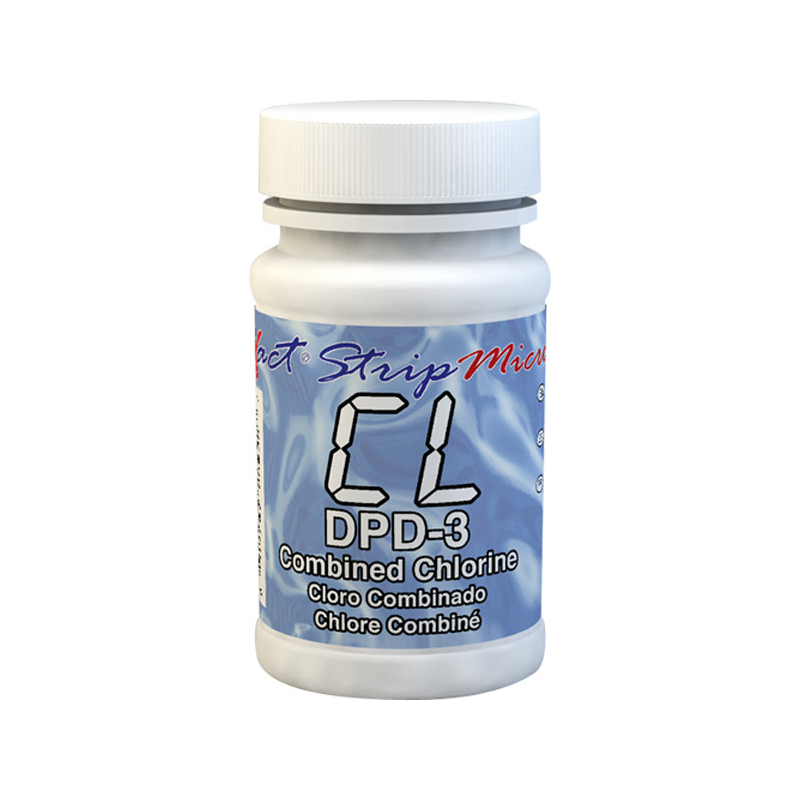
We offer this kit that lets you perform 100 tests with a photometer. Each strip contains a reagent at one end, allowing the device to accurately detect the combined chlorine level in your water.
This practical, easy-to-use test kit provides accurate results.
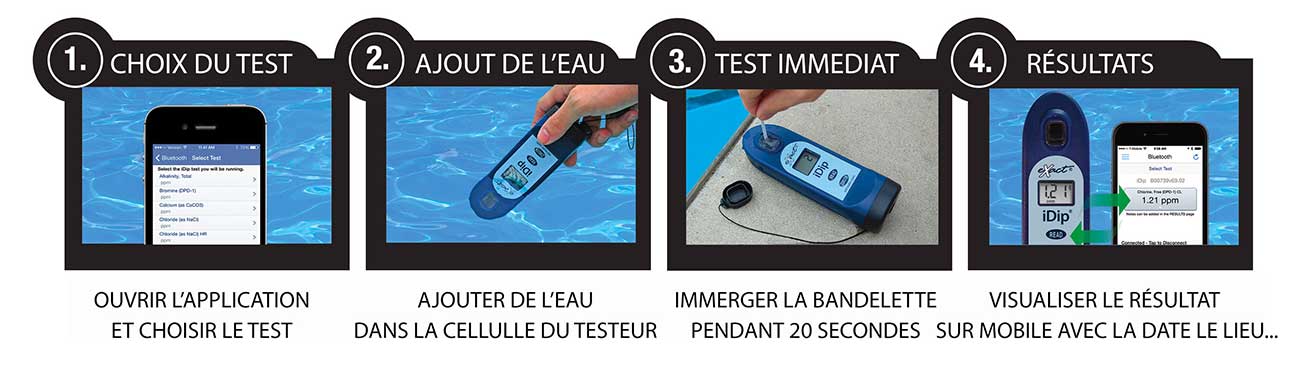
The testing procedure is very simple :
1. Open the app on your mobile phone and turn on the photometer.
2. Add water to the tester's designated sample cell.
3. Place the test strip in the water for 20 seconds.
4. View the result directly on the photometer. This result is automatically saved on your phone.
This water testing system is fast, reliable, modern, expandable, and comprehensive. It is THE most accessible system.
For additional information about how the device works, visit our dedicated iDip photometer page, where you can download the user manual in French.
This testing procedure is only valid when performed as a continuation of the free chlorine test.
 |
Have a test strip ready before you begin. Keep it in a dry, nearby, convenient location. Close the bottle immediately. |
 |
Dip the strip into the designated test cell and immediately press the READ button. This will start a 20-second countdown. During this time, gently move the strip in the cell with a slow back-and-forth motion. Remove the strip from the test cell as soon as the "1" on the screen disappears. |
 |
The cursor will move across the screen while the photometer prepares to test the sample. Record the displayed value. It is also automatically filed in MENU CL and saved in the app's "RESULTS". |
 |
Press the "READ" button and the photometer will start the countdown, then display the next reading. If this reading matches the previous one, record it as the total chlorine result. This value is automatically stored in MENU CL. After the test is complete, rinse the CELL IMMEDIATELY. Record the highest value displayed by the meter as your Total Chlorine result. After the test, immediately rinse the cell and clean it with the brush. |
Note : certain substances may interfere with combined chlorine test results.
| Substances that may interfere | Interference levels and treatments |
| Acidity | If the sample has an acidity greater than 150 mg/L CaCO3, the test may not develop full color. Neutralize to a pH of 6.0 to 7.0 with 0.5 N sodium hydroxide |
| Alkalinity | If the sample has an alkalinity greater than 200 mg/L CaCO3, the test may not develop full color. Neutralize to a pH of 6.0 to 7.0 with 0.5 N sulfuric acid. |
| Bromine and bromamines, Br2 | Produce a color similar to the free chlorine reaction at all levels. |
| Chlorine dioxide, CIO2 | The color is similar to the free chlorine reaction at all levels. |
| Copper Cu2+ | Color development is reduced above 10 ppm (mg/L). |
| Iodine, I2 | The color is similar to the free chlorine reaction at all levels. |
| Monochloramines (NH2Cl) (applies to DPD-1 only) | Monochloramine interference is known to occur in DPD methods for free chlorine. This interference depends on the temperature and monochloramine concentration |
| Ozone, O3 | The color is similar to the free chlorine reaction at all levels. |
| Peroxides | Interference is possible. |
| pH | Typical drinking water samples with a pH of 6.0 to 9.0 are acceptable. If the pH is outside this range, adjust it to a pH of 6.0 to 7.0 using acid (0.5 N sulfuric acid) or base (0.5 N sodium hydroxide). |