


Recherche dans le blog
FILTERING YOUR DRINKING WATER
The Health Benefits of RO Systems
- A quality drink
- Water that is easy to drink
- More reasons
- Your kidneys will thank you
- More advantages of RO systems
- RO water defined
- RO water and health
- RO water and aquariums
- RO water and pH
- RO water and demineralized water
- RO water or spring water?
- How to make RO water
- "An RO system is expensive" - Not anymore!
- What is the price of RO water?
Why You Shouldn't Drink Softened Water
- The reason given by the WHO
- More details on water softeners
- On the maintenance side
- An alternative to conventional salt-based water softeners
Should You Filter Tap Water in France?
- The official answer: No, water filtration is not necessary
- According to scientists: Yes, purifying your drinking water is essential
Can the Body Absorb Minerals in Drinking Water?
- An interesting study in Germany
- What does the WHO think?
- Water for dummies
- The study results
- The minerals in water are not bioavailable
- Other drawbacks of mineral water
A Closer Look at Dry Residue in Water
- Drinking water: a luxury in France?!?
- Pesticides and other little gifts found in tap water
- Just like VW, it's the limits that change, not the nature...
- Another big problem: water chlorination!
- Are we drinking medicated water?!?
- What goes unnoticed in sanitary tests...
- ...but not under the scrutiny of scientists, who even find heroin in tap water
- The conflict of interest of laboratories
Aluminum in Water Doubles the Risk of Developing Alzheimer's
What Is Ultrafiltration?
Ultrafiltration
What is ultrafiltration?
Ultrafiltration is, as its name suggests, a water filtration method. This water filtration system enables the removal of a large number of impurities present in water. Its main function is to remove viruses and bacteria present in water.
Explore water ultrafiltration systems
System components
First, the system is equipped with the same series of pre-filters as our RO systems: a polypropylene filter, an activated carbon block filter, and a granular activated carbon filter. The first filter removes large impurities such as sand and dust. Next come the activated carbon filters, which will remove chlorine and organic molecules.
How the membrane works
Finally, the water passes through the ultrafiltration membrane. This membrane works like a very fine 0.01μ sieve. Viruses, bacteria, organic macromolecules, colloids, nitrogen pollutants, and many other substances are thus filtered out to obtain healthier water.
Comparison with reverse osmosis
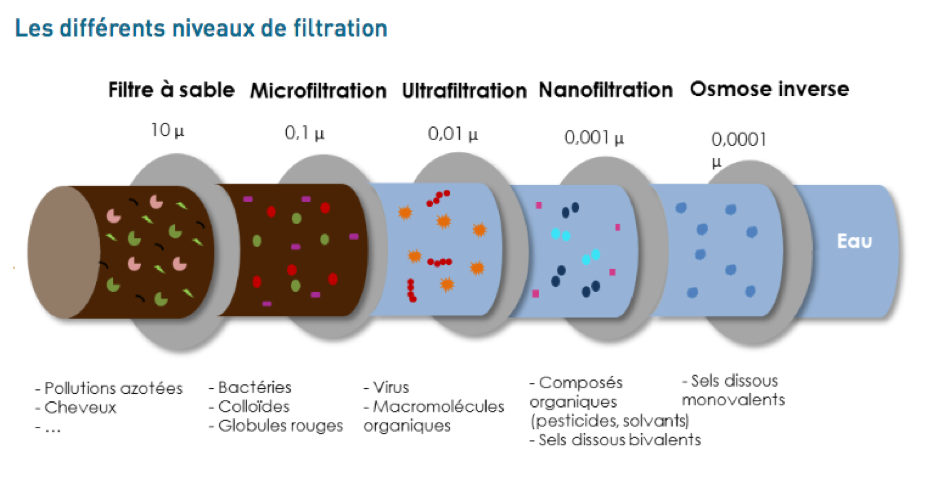
The two filtration systems do not work the same way. First, ultrafiltration filters at approximately 0.01 μ and an RO system at approximately 0.001 μ. You therefore get purer water with an RO system.
Although the pre-filtration system remains the same, the difference between the two systems comes when the water passes through the membranes. With ultrafiltration, the membrane acts like a very fine sieve and retains particles larger than 0.01 μ. In addition, an ultrafiltration system does not discharge water into the drain.
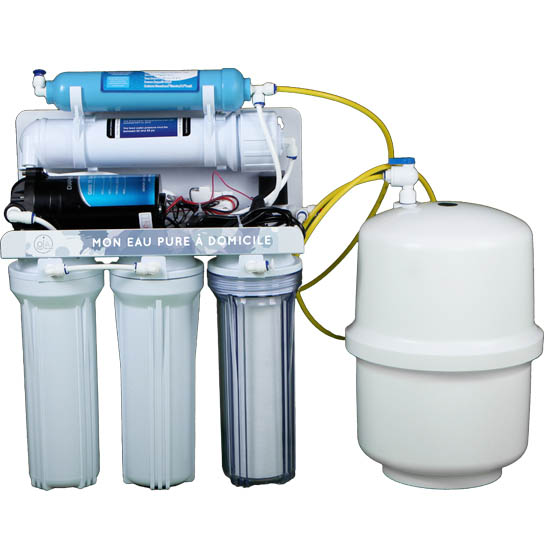
With reverse osmosis, however, it is a different story. The pressure exerted by the pump (or by the water supply) forces water through a semipermeable barrier. This barrier, whose pores measure only 0.0001 μ, lets only the smallest molecules through, namely water (H2O) and a few minerals (mainly calcium and magnesium). The water that does not pass through this membrane is discharged into the drain.
To sum up, ultrafiltration is good, but reverse osmosis is better in terms of filtration quality, although the latter method uses more water because of the wastewater.
- Published on
- FILTERING YOUR DRINKING WATER
Related blog posts
>-

What Is a Reverse Osmosis System?
What is an RO system? What does it do? How will it...
-

An RO System Without Wastewater?
Is there an RO system without wastewater? Why does an...
-
What Is a Reverse Osmosis System?
What is an RO system? What does it do? How will it...
-
An RO System Without Wastewater?
Is there an RO system without wastewater? Why does an...