


Recherche dans le blog
News
We occasionally have news to share in this category.
The Impact of the Lubrizol Fire in Rouen on Our Water Quality
A fire at the Lubrizol plant in Rouen
Introduction
At 2:40 a.m. on Thursday, September 26, 2019, a spectacular fire broke out at the Lubrizol plant in Rouen, a site classified as “Seveso”. The fire produced an enormous cloud of smoke that reached a maximum size of 22 kilometers long and 6 kilometers wide. This deep black, foul-smelling cloud initially headed toward the north and northeast of the country, particularly along the Rouen-Lille corridor, passing through Normandie and the Somme. According to meteorologists, the cloud was reportedly carried by winds from the southwest. The next day, the cloud crossed Belgium before continuing toward the Netherlands, where it kept dispersing and becoming more diluted with each passing moment.
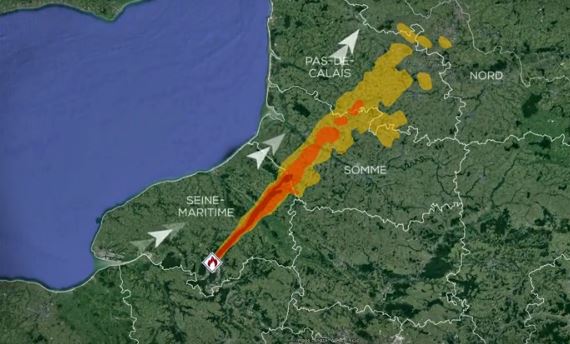
Image 1 : Illustration of the movement of the cloud from the fire at the Lubrizol plant in Rouen
Bans on collecting eggs, milk, and honey were introduced in Normandie and Hauts-de-France. The agence régionale de santé (ARS) of Hauts-de-France announced on Sunday, September 29, 2019, that soot sightings had been reported in Lille, the Aisne, and the Oise.
Meanwhile, in Belgium's province of Hainault, traces of soot from the Rouen fire were found. The crisis center advised residents to thoroughly air out their homes, wear gloves when cleaning up residue that had fallen from the sky, and thoroughly wash all locally grown fruits and vegetables. As concentrations continued to decrease over time and with dilution, the Netherlands did not appear to be taking any specific measures.
Why so many measures?
To understand all the measures taken by the various European governments in response to the cloud released by Lubrizol's Rouen site, you first need to understand what a Seveso-classified site is. The term shares its name with an Italian town in Lombardy. In July 1976, this town experienced an explosion at a chemical plant that produced a cloud of dioxin that spread around the town. Since this incident, the term has been associated with a European directive intended to control major accidents involving dangerous substances. Currently, a company designated “Seveso” carries out activities involving the handling, manufacturing, use, or storage of “dangerous substances”. A fire at one of these facilities could therefore potentially release harmful substances that would need to be contained by every available means.
The Lubrizol plant, classified as an upper-tier Seveso site, therefore contained products classified as dangerous. The weekly magazine Marianne reveals that: “Of the 5,253 metric tons of substances present in the warehouse, 856 metric tons fell, under the classification established by the institut national de l'environnement industriel et des risques (Ineris), into the hazard category "H304" : "May be fatal if swallowed and enters airways".
"Among the ten products stored in the largest quantities in the burned warehouse—which did not all burn completely—some bear, among others, the label H360F – "May damage fertility or the unborn child", or H412 : "Harmful to aquatic life with long-lasting effects". In plain terms, the agence européenne des produits chimiques (ECHA) classifies the various types of petroleum distillates listed by Lubrizol as potentially carcinogenic."
This passage does not mention the 8,000 m² of asbestos roofing that went up in smoke. It is therefore understandable that nearby residents and regions bordering Seine-Maritime were concerned. But, as the department's prefect, Pierre-André Durand, says: “As at many industrial sites, there is asbestos. There is no need to worry about it in the air; that is perfectly clear. However, there is asbestos at the plant site, and very extensive restoration work will need to be carried out.”
The toxic substances detected, such as mercaptan, acrolein, dioxin, asbestos, furans, PAHs (polycyclic aromatic hydrocarbons), and heavy metals (lead ; cadmium, mercury) etc... were reportedly present in quantities too low to be considered harmful.
However, as Health Minister Agnès Buzyn points out: “I cannot say there is no danger; there are inevitably traces of hydrocarbons.”
Ultimately, what is most worrying is not the result of burning known hydrocarbons but all the products whose transformation due to partial combustion is not yet understood. And, as court-appointed expert and chemical engineer Frédéric Poitou points out, only one hundredth of the measurements needed to determine what is actually being released into the air and into the water supply have been carried out so far. It is therefore impossible to draw conclusions about whether the smoke and ash resulting from the fire are inert or harmless. However, we already know that the smoke contains asbestos, heavy metals (lead++), mercaptan, hydrocarbons, and other carcinogenic substances… We still need to determine their concentrations and their effects on the environment and the health of our fellow citizens.
"We have dangerous products, we have dangerous combustion products; to determine whether there is a health risk, we need exposure data" that is still lacking, Fabrizio Pariselli, a toxicologist at the CNRS chemical risk prevention unit, tells AFP. The Health Minister can therefore only offer reassurance: "This pollution is real, but for now, based on what we know today, it poses no health risks." As for tomorrow, it is too early to say.
The experts' views
Today, Anses's conclusions are reassuring. As of Monday, October 21, 2019, the concentrations of potentially dangerous substances that can currently be measured are below the maximum regulatory levels. This is why restrictions on honey, farmed fish, eggs, and certain fruits and vegetables have been lifted, except in a few areas of the Somme that still exceed the maximum permitted levels. Over the long term, soil pollution caused by the incident is expected to have consequences for fields and groundwater.
In this article, I will let you listen to the equally rational and objective views of chemical engineer and court-appointed expert Frédéric Poitou, which will also serve as my conclusion : https://www.youtube.com/watch?v=_wm877pVvdc

Sources :
https://www.youtube.com/watch?v=_wm877pVvdc
https://www.sudouest.fr/2019/10/21/lubrizol-miel-oeufs-legumes-de-nouvelles-levees-de-restrictions-6728331-4696.php
- Published on
- News,
- REVERSE OSMOSIS
Related products

Related blog posts
>-

Perchlorate in Municipal Water Supplies
Health problems related to perchlorate in French...
-

Are France’s Rivers Polluted?
More than 90 % of France’s rivers are reportedly...
-

Plastic Water Bottles: A Chronicle of Global Pollution
Plastic water bottles are among the many types of...
-

The Water Situation in France
The water situation in France is barely any brighter...
-

The Condition of Water in Nature.
Water found on the surface of the earth or within it...
-
Perchlorate in Municipal Water Supplies
Health problems related to perchlorate in French...
-
Are France’s Rivers Polluted?
More than 90 % of France’s rivers are reportedly...
-
Plastic Water Bottles: A Chronicle of Global Pollution
Plastic water bottles are among the many types of...
-
The Water Situation in France
The water situation in France is barely any brighter...
-
The Condition of Water in Nature.
Water found on the surface of the earth or within it...