Recherche dans le blog
News
We occasionally have news to share in this category.
The Chlordecone Problem in the French Antilles
The chlordecone problem in the French Antilles
Introduction
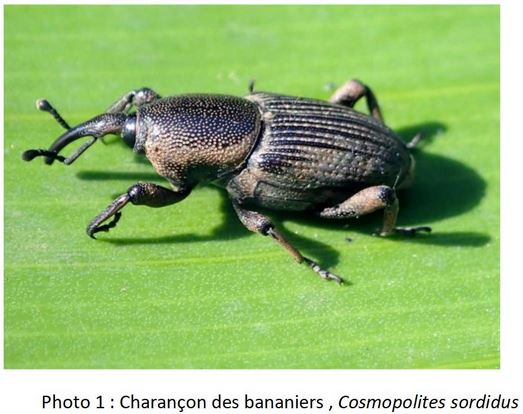
Chlordecone is an organochlorine insecticide designed to eradicate the banana weevil , or Cosmopolites sordidus. This active ingredient was therefore used as a powder spread over banana plantations, as well as citrus and tobacco fields. In France, this active ingredient was found in Kepone ®, Merex ® and GC 1189® products.
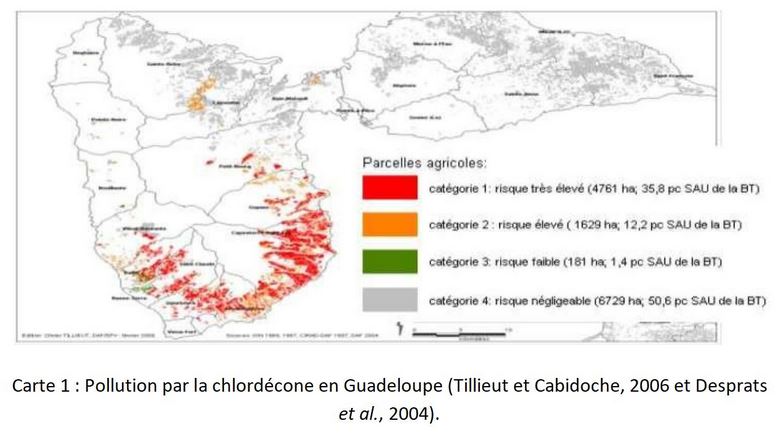
In 1975, following an industrial accident at the Kepone® production site ,in Hopwell, Virginia, chlordecone concentrations above 1,000 μg/l were found in workers' blood. These high concentrations were associated with numerous symptoms describing “Kepone syndrome,” characterized by nervous system damage (tremors, short-term memory loss, mood disorders...), an enlarged liver and reduced male fertility. In most cases, the symptoms disappeared a few years after exposure ended.
In 1977, chlordecone was banned in the United States.
In 1979, the World Health Organization (WHO) classified chlordecone as a “possible carcinogen”.
However, chlordecone was used in France from 1971 to 1990. Despite the bans on its use introduced in 1990, legislative ambiguity allowed two successive exemptions, signed by the agriculture ministers at the time, that authorized its use in the Antilles until 1993. Despite the bans introduced, some farmers are known to have continued using this insecticide illegally for a few years.
In 2007, the United Nations Environment Programme (UNEP) defined chlordecone as a “persistent organic pollutant” (=POP). It is therefore a “substance that persists (against biotic and abiotic degradation), is highly bioaccumulative, and can be transported over long distances and found ubiquitously in the environment”. The criteria used for POP classification are defined in Annex 5 of the Stockholm Convention (under the auspices of UNEP).
Since this compound has been banned for decades, why is it still a problem?
According to studies conducted by INERIS, chlordecone, with the formula C10Cl100, is a molecule with great chemical stability, making it highly persistent. Tests show that:
· Through hydrolysis, “no degradation reaction is expected under environmental conditions”
· “Direct photolysis of chlordecone is not significant”
· “Chlordecone is not readily biodegradable”
Furthermore, this active ingredient has a half-life of 10 years, meaning it will still be active more than 600 years from now.

Image 1 : Representation of the chemical structure of chlordecone
Chlordecone is known to have low solubility and low volatility. However, its affinity for organic matter in soil is very high. It will therefore primarily be adsorbed onto organic matter through low-energy bonds. Surface water running off former crop fields can also contain chlordecone. In this case, the contamination is associated with particles suspended in the water. Chlordecone is also observed migrating toward deep groundwater when the soil has a high clay content, is very poor in organic matter or has been heavily contaminated .
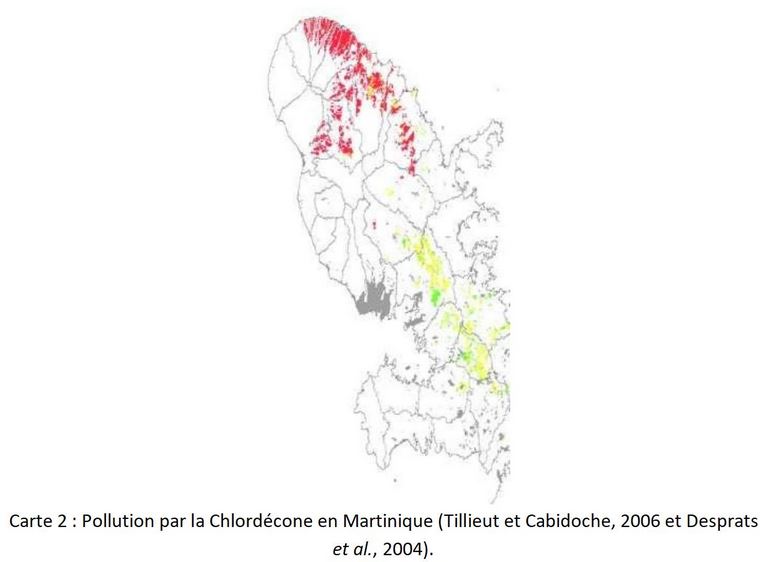
This excerpt from a study conducted by the Institut National de l'Environnement Industriel et des Risques (INERIS) shows that chlordecone is indeed present in sludge, water from abstraction sites and seawater. In other words, chlordecone enters the food chain through many foods:
- Vegetables, particularly roots and tubers such as sweet potatoes, yams and carrots, and intermediate plant crops such as vegetables in the cucurbit family, as well as lettuce, sugarcane, etc.
- Algae, and other aquatic plants, certain invertebrates and fish from contaminated areas, in both freshwater and seawater.
- Municipal water, or tap water
Chlordecone bioaccumulation therefore extends throughout the food chain until it reaches our plates.
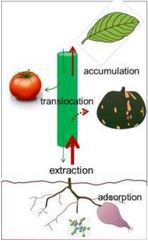
Image 2 : Diagram of plant contamination by chlordecone
We already know that the entire Antilles region is affected by this problem. In June 2018, the newspaper Le Monde reported that almost all of the 800,000 inhabitants of Guadeloupe (95%) and Martinique were now contaminated. This study naturally includes pregnant women and infants.
The consequences for the population
Chlordecone is an endocrine disruptor, meaning it interferes with the hormonal system. INSERM now states that it may affect estrogenic, progestogenic and thyroid activity in particular, potentially impacting adults, children, pregnant women, fetuses and infants.
The Timoun cohort study, conducted between 2004 and 2007 with a sample of 1,068 pregnant women, identified symptoms associated with the systemic presence of chlordecone in pregnant women. The study drew conclusions about the course of pregnancies and behavioral development at 7 and 18 months. Follow-up of the children continued until age 7.
The Timoun study shows that the higher the concentration of chlordecone in the blood, the shorter the pregnancy, thereby increasing the risk of premature birth (before 37 weeks of gestation, counted from the last menstrual period).
Chlordecone systematically crosses the placental barrier, enters the umbilical cord (in 56% of cases in the Timoun study) and passes into breast milk, although at low concentrations (for this reason, breastfeeding is still recommended in the child's best interest based on the balance of benefits and risks). However, exposure to chlordecone remains constant and sometimes has consequences, particularly for the thyroid system. 150 children in this study were followed at 7 and 18 months. Thyroid dysfunction was shown to affect psychomotor development following both prenatal and postnatal exposure. After 18 months, only fine motor development in boys was still affected.
The Karuprostate study showed that the greater the exposure to chlordecone, the greater the risk of developing prostate cancer or experiencing a recurrence of prostate cancer. Depending on an individual's metabolism, the carcinogenic substance is eliminated more or less effectively. Naturally, individuals who eliminate it more slowly have a higher risk of developing cancer.
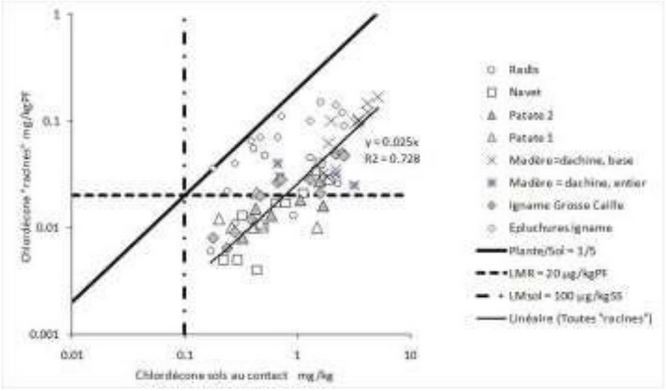
Image 3 : Proportional relationship between contamination of harvested underground plant organs and the chlordecone content of nearby soil : definition of an upper-bound relationship (thick black line) allowing the maximum residue limit in food (MRL) to be converted into a maximum soil contamination limit below which cultivation is permitted.
Conclusion
Here is the ARS's conclusion on chlordecone : “Epidemiological studies are continuing (Timoun cohort, new studies planned on liver cancer, breast cancer and prostate cancer recurrence). They have already shown short-term effects of chlordecone during critical windows of exposure (pregnancy and child development) and possibly long-term effects (cancer). Efforts to reduce exposure must therefore be maintained, if not strengthened”. You should therefore avoid drinking municipal water in the Antilles and choose bottled water or RO water instead.
Sources
Agronomie, environnement & société, June 2012, volume No.2/issue 1, P45- Chlordecone in the Antilles : changes in cropping systems and their impact on the spread of contamination, M. LESUEUR-JANNOYER, P. CATTAN, D. MONTI, C. SAISON, M. VOLTZ, T. WOIGNIER, Y.M. CADIBOCHE (Cirad, Ird, Inra, CNRS)
INERIS : ENVIRONMENTAL GUIDELINE VALUE, CHLORDECONE– CAS No. : 143-50-0 Expert group validation : November 2012, Version 3 : 24/03/2013, Page 4
- https://www.martinique.ars.sante.fr/system/files/2017-08/7%20-sant%C3%A9-Vweb2.pdf
- https://www.pourquoidocteur.fr/Articles/Question-d-actu/25880-Cancers-bebes-prematures-Antillais-massivement-empoisonnes-chlordecone
- https://www.sciencesetavenir.fr/sante/le-chlordecone-un-pesticide-a-la-dangerosite-demontree_127972
- https://www.lemonde.fr/planete/article/2018/06/06/scandale-sanitaire-aux-antilles-qu-est-ce-que-le-chlordecone_5310485_3244.html
- Published on
- News
Related products


Related blog posts
>-

The Impact of Sulfate on Your Health
Sulfate is a chemical compound naturally present in...
-

Perchlorate in Municipal Water Supplies
Health problems related to perchlorate in French...
-

The Impact of Chlorine on Your Health
Chlorine is a chemical element naturally present in...
-
The Impact of Sulfate on Your Health
Sulfate is a chemical compound naturally present in...
-
Perchlorate in Municipal Water Supplies
Health problems related to perchlorate in French...
-
The Impact of Chlorine on Your Health
Chlorine is a chemical element naturally present in...