


Recherche dans le blog
A Splash of Articles
In this category, we let our inspiration guide our writing about water!
The Different Types of Filtration Systems
Today, although the water in your pipes is safe to drink, it still contains certain chlorides, sulfates, nitrates, pesticides, or other heavy metals. It also contains many bacteria and, depending on the region, varying amounts of limescale.
When you see this explosive cocktail, you want to filter the water in your home, and rightly so.
But your reasons can be many and varied. For every reason, there is a water filtration system that is best suited to it.
Below, we will introduce you to the different filtration systems available and their benefits.
Water filter pitchers
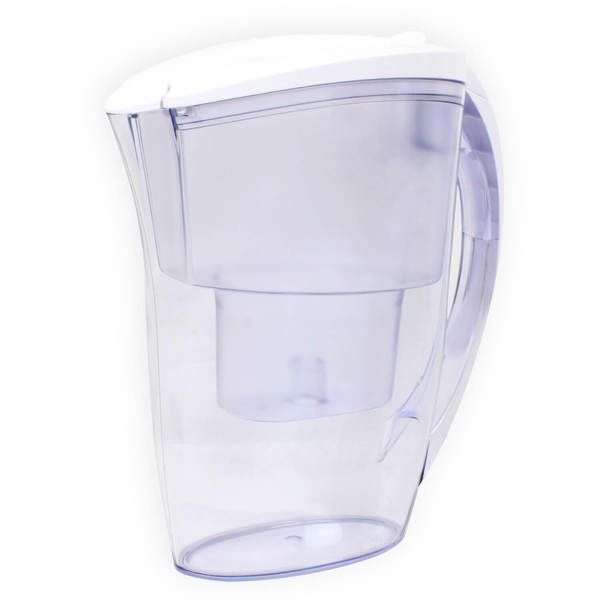
Widely available on the market, with more than 2 million sold each year, water filter pitchers attract many consumers because of their convenience and low price.
Today, nearly 250 million people drink water using a Brita pitcher.
But what do these pitchers actually filter?
Water filter pitchers are equipped with activated carbon filters. These remove the taste of chlorine. However, chlorine acts as a bactericide. These pitchers therefore lose some of their bactericidal capacity. In fact, when kept at room temperature, an activated carbon filter more readily develops bacterial germs.
This is why some manufacturers have added silver particles to address this problem.
Indeed, silver particles, like chlorine, have bactericidal properties.
As a result, the chlorine disappears, but you end up with silver particles!
What about nitrates? After conducting analyses, we concluded that only 8 % to 17 % of nitrates are retained.
In conclusion, water filter pitchers retain only a small portion of the unwanted substances. In addition, water left standing in a pitcher accumulates all these retained substances. You should therefore remember to keep the pitcher in the refrigerator and not drink water from the previous day.
The water softener
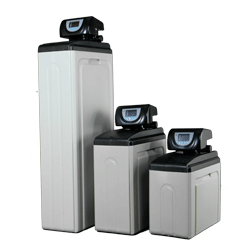
To protect your installation from corrosion or limescale, you need to check your water quality. If the water is too hard, as it tends to be in many geographic areas, your fixtures will become covered in limescale!
The water softener is the answer to this problem!
Indeed, the main purpose of a water softener, whether salt-based or salt-free, is to get rid of limescale.
Aren't you tired of having to clean the limescale that builds up on your sink or fixtures every week? Has your equipment's performance declined?
A water softener allows you to eliminate every trace of limescale in your home or on your glasses or utensils, while also protecting your pipes and scale-covered appliances. Your skin is no longer dried out by the limescale in your shower water, and your clothes are softer.
You will restore your appliances' performance and save on maintenance and equipment replacement. You will therefore save time and money!
Water softeners come in several forms. They can work for an entire house, but also in a more localized way, like the Scalex softening system.
Ultrafiltration
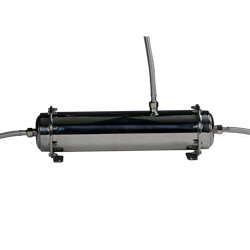
Developed in the 1970s by industry to eliminate bacteria and viruses, ultrafiltration is a filtration technique that uses specific membranes with pores 0.01 micron in diameter, or 10,000 times finer than a human hair.
This technique also removes phagocytes, colloids, and macromolecules to a certain extent.
Ultrafiltration makes water that is already clear, but may contain unwanted particles, safe to drink. It is therefore not suitable for seawater or excessively polluted water. However, this technique cannot remove limescale from water. For that, you will need a water softener.
An ultrafiltration system can be connected to the main water supply pipe and can filter all the water in your home without any wastewater!
It is the ideal installation for having clean water and being able to wash under optimal hygienic conditions.
The reverse osmosis system
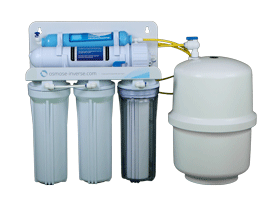
The reverse osmosis system is the Rolls-Royce of filtration systems. Initially developed by Nasa to allow astronauts to recycle water during their missions in space, the RO system has become widely accessible and is now sold to industries, professionals, and individuals alike!
The RO system allows you to purify water in the best possible way.
It consists of several parts that play a role in the process. The initial pre-filters remove the largest particles, such as dust or sand, as well as all the chlorine.
The water then passes through a reverse osmosis membrane, where only the smallest minerals (calcium and magnesium) can pass through.
The RO system therefore removes heavy metals, pesticides, pharmaceutical residues, fluorine, chlorine, and many other impurities!
However, during this process, the RO system discharges a certain amount of water. This installation is therefore intended primarily for use with a specific faucet. Unless you have an industrial RO system, which would be extremely expensive, you cannot purify all the water in a house with an RO system.
You can therefore install it under your kitchen sink and install a faucet to enjoy as much pure drinking water as you want!
- Published on
- A Splash of Articles
Related blog posts
>-

What Is a Reverse Osmosis System?
What is an RO system? What does it do? How will it...
-

Why Soften Your Water?
Wondering why it is important to soften your water?...
-
What Is a Reverse Osmosis System?
What is an RO system? What does it do? How will it...
-
Why Soften Your Water?
Wondering why it is important to soften your water?...