


Recherche dans le blog
Test Your Water or Have It Tested
What Is Drinking Water?
If you want to have your water analyzed, you are probably asking yourself : is my water safe to drink?
If you draw water from your well, or live in the countryside near a river, the question of whether natural water is safe to drink is an obvious one. But how can you tell whether water is actually safe to drink?
How is drinking water defined?
Drinking water is fresh water considered biologically and chemically safe that you can drink or use for cooking without becoming ill in the short term. This is a fairly vague definition, since the criteria that define drinking water vary as widely as the countries around the world and go far beyond measuring pH levels! There are actually more than 60 criteria, which can be organized into 7 groups :
- organoleptic : color, odor, taste…
- physicochemical : pH, dissolved oxygen…
- undesirable substances : nitrates, hydrocarbons…
- toxic substances : arsenic, cyanide, cadmium…
- microbiological : coliforms, streptococci…
- pesticides and related products : aldrin, dieldrin, heptachlor…
- softened water
It is important to note that water considered safe to drink is not necessarily completely free of pollutants. Its concentration of pollutants is simply considered low enough not to harm consumers' health. Only a thorough long-term study could establish whether water defined as safe to drink is actually entirely harmless to human health over the long term.
The World Health Organization (WHO) published the 3rd version of the “International Standards for Drinking-Water” in 2017, but unfortunately, studying water quality reveals that some governments have no hesitation about regularly lowering drinking water standards. Water considered safe to drink in France today would therefore not have met the standards in the 1950s! Science without conscience…
A brief reminder : the European Water Charter

We feel it is important to publish the European Water Charter :
1. There is no life without water. It is a precious resource, essential to all human activities.
2. Freshwater resources are not inexhaustible. It is essential to preserve them, monitor them and, if possible, increase them.
3. Degrading water quality harms human life and the other living beings that depend on it.
4. Water quality must be maintained at levels suited to its intended use and must, in particular, meet public health requirements.
5. When water is returned to the natural environment after use, it must not compromise subsequent uses, whether public or private.
6. Maintaining appropriate vegetation cover, preferably forests, is essential to conserving water resources.
7. Water resources must be inventoried.
8. Proper water management must follow a plan adopted by the competent authorities.
9. Protecting water requires a major effort in scientific research, specialist training and public information.
10. Water is a shared heritage whose value must be recognized by everyone. Everyone has a duty to conserve it and use it carefully.
As is often the case, it seems our fine politicians have been overwhelmed by events…
The WHO definition of drinking water
The WHO publishes reports, particularly on water quality, which is a major international issue.
You can download the report : Guidelines for Drinking-Water Quality by clicking the following link : https://www.who.int/water_sanitation_health/publications/drinking-water-quality-guidelines-4-including-1st-addendum/fr/
The 564-page report is somewhat hard to digest (no pun intended), but comprehensive. It presents current knowledge about how bacteriological, chemical and radioactive elements affect humans through drinking water.
Drinking water criteria in France :
The website of the Ministère des Solidarités et de la Santé provides a tool for reviewing drinking water monitoring results :
https://solidarites-sante.gouv.fr/sante-et-environnement/eaux/article/qualite-de-l-eau-potable
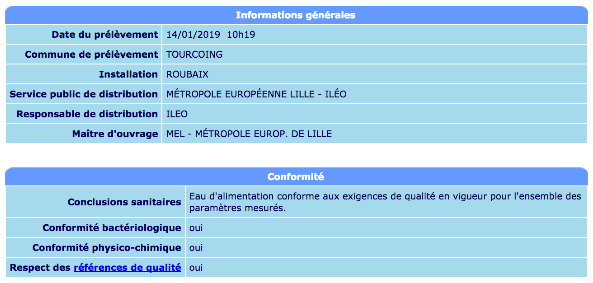
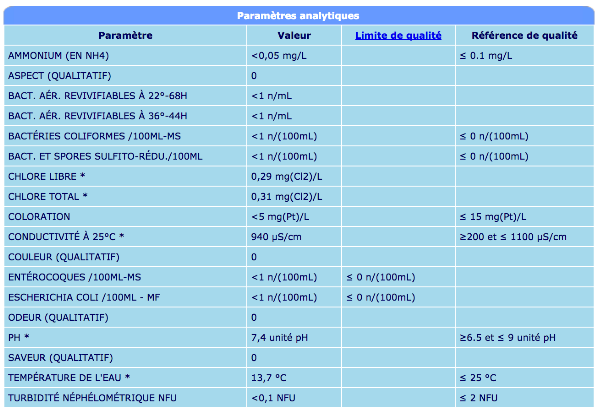
After you select your region and municipality, the government provides a water analysis table. Congratulations on the transparency. At first glance.
Here are the results for our headquarters, based in Roubaix :
The 63 criteria for drinking water safety can be grouped into 5 main parameter categories :
Physicochemical parameters
These take into account water characteristics such as :
- pH,
- temperature,
- conductivity
- water hardness…
They also specify the maximum amounts of certain components, such as ions, chlorides, potassium and sulfates.
Examples of required maximum amounts :
- Sulfate content ≤ 250 mg/l
- Chloride content ≤ 200 mg/l
- Potassium content ≤ 12 mg/l
- Water pH : 6.5 ≤ pH ≥ 9
Organoleptic parameters
These parameters, which take into account water color, taste and odor, have no direct health significance but relate to how pleasant the water is to drink : water must be pleasant to drink, clear and odorless.
Microbiological parameters
On the hunt for microbes, viruses, bacteria and parasites! Microbiological parameters screen for pathogens that cause diseases or epidemics.
Undesirable substance parameters
Many substances end up in water as a result of industry, livestock farming or intensified crop production, yet are harmful to humans. These parameters screen for nitrates, nitrites and pesticides.
- Maximum nitrate content < 50 mg/l
- Maximum fluoride content < 1.5 mg/l
Toxic substance parameters
Some micropollutants are extremely toxic and therefore subject to very strict standards, with permitted amounts on the order of one millionth of a gram. These include : arsenic, cyanide, chromium, nickel, selenium and certain hydrocarbons. These are actual poisons that must never be consumed!
Concluding thoughts on drinking water
Water deemed “safe to drink” has therefore had bacteria and viruses removed (most often using chlorine, which is harmful to our health in the long term) and meets arbitrary, variable limits for a whole range of other parameters (heavy metals, chlorides, nitrates, fluorides…).
You therefore cannot become ill in the short term from drinking water officially deemed safe to drink! But what about the long term, or substances that are not tested for? Increasingly, in-depth scientific studies show that heavy metals, hormones, drug residues, plastic residues and other delights contribute significantly to the development of multiple diseases after years, or even decades of consuming water that is safe to drink but not truly healthy.
Our primary mission is to inform our fellow citizens and offer them effective solutions at a fair price. We are committed to sharing our water research so that more and more people are informed – above all, with reliable, real data. We feel that our governments are manipulating us. It is so easy to change a standard so that water is considered safe to drink, even when its quality has declined… much easier than implementing real policies for water treatment or environmental protection…
We have therefore decided to offer attractive prices for all the items sold on our website, including test kits and the tests we arrange through our partner laboratory. J’osmose is, of course, a commercial business, but one committed to sharing its convictions and its commitment to serving nature.
And by protecting everyone's health with healthy water, we will also be able to protect our planet. At least, it is a good start!