


Recherche dans le blog
What Is a Water Softener For?
What is a water softener?
A water softener is a device installed at the inlet of your water supply system that works as an ion exchanger. In short, it replaces the calcium ions (Ca2+) responsible for limescale formation with sodium ions (Na+) using the salt (NaCl) present in its resin.
Why should limescale be removed from water?
Limescale causes scale buildup in pipes. When calcium ions come into contact with bicarbonate, or hydrogen carbonate, they react to form limescale, CaCO3. These limescale molecules have the distinctive property of clinging to the walls of your pipes, reducing their internal diameter day after day. As a result, less and less water can flow through your pipes, and internal pressure increases even as the flow rate decreases. In the long run, breakage is guaranteed!
Another advantage of having soft water is that your skin immediately becomes softer too. At today's prices for moisturizing creams, that represents considerable savings...
Am I affected? Do I need a water softener?
You can refer to the map below to see your chances (or misfortune!) of being affected by water hardness.
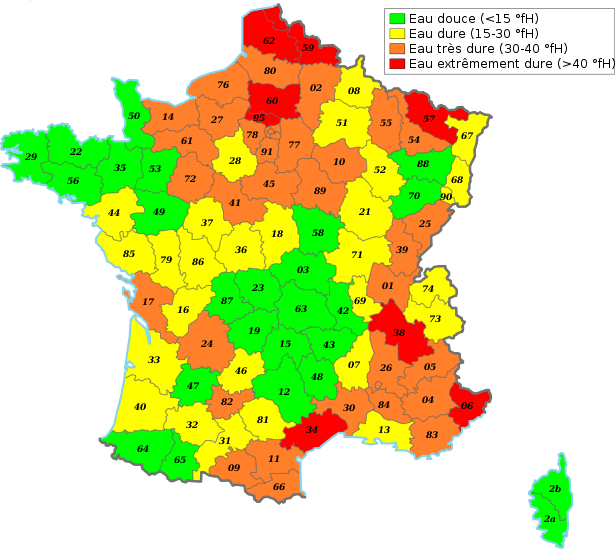
If you live in a yellow, orange, or red area, you need to soften your water to protect your pipes.
Is installing a water softener complicated?
We all thought so, but it actually isn't that complicated...
The most complex part is not installing the water softener, but preparing the plumbing beforehand so you can install it.
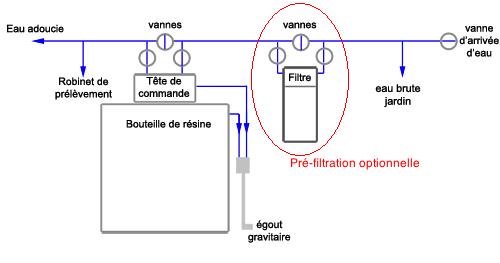
As you can see in the diagram below, you need a little space between the water meter (water inlet valve) and the various branches supplying the entire house. You need to be able to install several shutoff valves to manage the water softener's water supply easily. This involves cutting, extending, and soldering your copper pipes ; so you will need a plumber for a few hours, unless you are a dedicated DIYer.
Note: You also need a nearby power outlet to plug in your water softener's electronic control system and a wastewater drain.
The rest, however, is very easy! Simply screw the flexible hoses supplied with your water softener onto the previously installed valves. Use the supplied Teflon to guarantee a perfect seal on your fittings. Tighten them with open-end or adjustable wrenches. Connect the 2 small drain tubes (one for the tank overflow and one for resin regeneration) to your drain trap, and all that is left is to plug your water softener into the power supply.
How do I set up my water softener?
Setting up a water softener involves two steps.
1) Setting the time
Setting the time is important for one reason: to avoid shutting off the water for resin regeneration when you need it.
By default, regeneration takes place at 2 a.m., but you can choose any time that suits you. Make sure you also set the current time so your water softener does not think it is 2 a.m. in the middle of the day.
If you make a mistake with the settings and regeneration starts when you need water, don't panic: that's what the valves are for! Simply open the bypass valve to temporarily bypass the water softener. You will just have untreated water during that time ; which is no disaster once in a while.
2) Setting the regeneration volume
The frequency of resin regeneration in a water softener is THE most important point. Your water's hardness depends directly on this setting.
For our entire range of water softeners, we have chosen a volumetric meter that always regenerates the resin at the right time, keeping hardness perfectly stable.
To calculate the volume of water between regenerations, use the following formula:
Regeneration volume = Resin volume x 6,000 / TH
The resin volume depends on the size of the water softener you have chosen. TH (water hardness) must be measured with a very simple chemical test: it corresponds to the number of drops of a liquid (sold in any home improvement store) added to 5 ml of your water when the mixture turns green.
Note: If the mixture does not turn red first, your water is already too soft.
For example, if I install our midrange model containing 7 liters of resin in my home and my water hardness is 30, I set the regeneration volume to 7 x 6,000 / 30 = 1,400 liters. Then, once the 1,400 liters of water have been used, my water softener will wait until 2 a.m. and start a one-hour regeneration cycle.
What next?
Once your water softener is set up, all you need to do is replenish the salt regularly (about one-third of the tank) and test your water hardness once a year to check that the settings are still optimal.
Caution: Softened water contains a high level of salt and should not be drunk daily. We therefore recommend installing a second faucet on your sink supplying untreated water, or better yet: RO water!
If you have any other questions, contact us.
Until then, we wish you a soft and soothing day!
Related blog posts
>-

Why Should You Avoid Drinking Salt-Softened Water?
The effects of softened water on your health, your...
-
Why Should You Avoid Drinking Salt-Softened Water?
The effects of softened water on your health, your...