Recherche dans le blog
Featured Articles
Articles in the category "Featured Articles"
What Is Ultrafiltration?

Ultrafiltration: another sustainable alternative to reverse osmosis?
In water treatment, ultrafiltration offers a gentler solution than reverse osmosis. It uses less water and energy, preserving essential minerals while removing a large proportion of impurities. Let's explore how this technology works, its benefits, and its limitations.
How does ultrafiltration work?
Ultrafiltration is a membrane filtration technique that uses larger pores than reverse osmosis. It traps bacteria, viruses, parasites, some organic matter, and suspended particles, while allowing mineral salts and trace elements to pass through.
An ultrafiltration system includes:
- Preliminary filter
- Ultrafiltration membrane : filters down to 0.01 micron (vs. 0.0001 for reverse osmosis)
- Direct outlet : no tank needed, no wastewater
The benefits of ultrafiltration
- No waste : all filtered water can be used
- Minerals preserved : unlike reverse osmosis
- Simple installation and lower cost
Limitations to be aware of
- Less thorough filtration: ineffective against nitrates, pesticides, and heavy metals.
- Less suitable for heavily polluted water.
Ultimately, reverse osmosis or ultrafiltration? Which should you choose?
There is no definitive answer to this question; it depends mainly on your needs:
- For extremely pure water, choose reverse osmosis.
- For environmentally friendly filtration that preserves minerals, ultrafiltration is ideal.
To learn more : Read our full article on reverse osmosis to better understand the differences and make an informed choice.
- Published on
- Featured Articles,
- FILTRATION TECHNIQUES
Related blog posts
>-

What Is Reverse Osmosis?
Reverse osmosis is an extremely effective water...
-
What Is Reverse Osmosis?
Reverse osmosis is an extremely effective water...
Related products
-

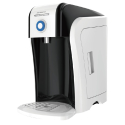
Oja Ultimeau Ultrafiltration Dispenser FONTAINE-ULTRA